

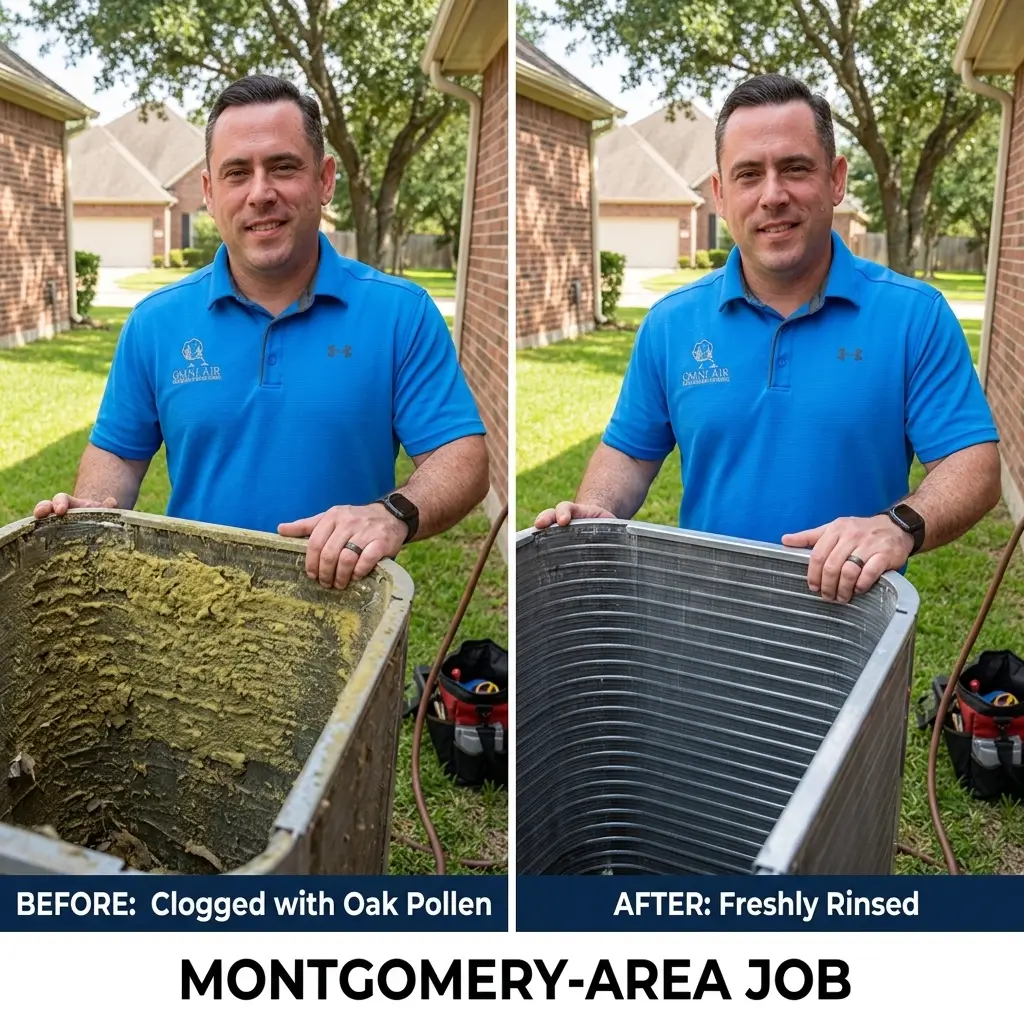
Most of the no-cool calls I run in July trace back to something a spring tune-up would have caught. A capacitor that was already reading low. A drain line half full of sludge. An outdoor coil packed with oak pollen and grass clippings. Those parts wear down for months, then quit on the hottest afternoon of the year.
This HVAC maintenance checklist for Montgomery TX homeowners is the one I use on my own service calls. It covers what you can safely do yourself, what a real tune-up should measure, and the local details national checklists skip.
Quick answer: Montgomery County homes need two professional visits a year. Book the spring AC tune-up in late March or April, after the oak pollen peak. Book the fall heating tune-up in October or early November. Between visits, check the filter monthly, keep the outdoor unit clear, and look at the attic drain pan a few times each summer.
How I know this: I am a licensed HVAC technician with Omni Air & Heating LLC. I run spring and fall tune-ups every year across Montgomery, Conroe, Willis, The Woodlands, Magnolia, and the Lake Conroe communities. The readings and mistakes below come from my own service tickets. Our Texas license, TACLA105873C.
Your Montgomery County HVAC Maintenance Checklist Calendar
| When | What You Do | Professional Visit |
| Late March to April | New filter, rinse outdoor coil, flush drain, test cooling | Spring AC tune-up |
| May to September | Check filter monthly, keep unit clear, check attic pan | Only if something changes |
| June 1 to November 30 | Hurricane season: photograph equipment labels | After flooding or damage |
| October to early November | New filter, test heat and CO alarms | Fall heating tune-up |
| December to February | Keep heat pump clear of leaves and ice | Only if something changes |
What Generic HVAC Maintenance Checklist Miss About Montgomery County
The top-ranking checklists cover filters, coils, and refrigerant well. They miss how our climate and our homes change the timing and the checks.
Oak Pollen Changes When You Should Book
ENERGY STAR suggests planning check-ups around the spring and fall time changes, noting that contractors get busy “once summer and winter come.” That works in most states. Here, the March time change lands in the middle of oak season. The Houston Health Department, which runs a certified pollen counting lab, says Texas oak pollen “typically peaks in mid-late March.” I have cleaned coils in early March and found them yellow again two weeks later.
Many Air Handlers Here Sit in the Attic
Drive through the newer neighborhoods off Highway 105 or FM 1097 and a lot of homes have the indoor unit in the attic. That puts a clogged drain line directly over your ceiling. I check the secondary drain pan and float switch on every visit. If you have ever found a water stain under the attic unit, you know why that matters.
Your AC Still Works Hard in October
Our cooling season runs past Labor Day, so a fall visit here doubles as a last look at the AC.
Backup Heat Strips Sit Unused for Months
Heat pump homes can go most of a winter without running their electric heat strips, then need them all day in a freeze. During Winter Storm Uri, the Texas Comptroller reported a University of Houston survey finding that 69 percent of Texans lost power at some point from February 14 to 20, 2021. A burned strip or a stuck relay is something I want to find in October, not during a week like that.
Spring HVAC Maintenance Checklist (Late March to April)
Spring Tasks You Can Do Yourself
- Swap the filter after the pollen drops. If you cannot see light through the old one, it was overdue. See how to change your AC filter for sizes and MERV ratings.
- Rinse the outdoor coil. With the power off at the thermostat and outdoor disconnect, spray the fins with a garden hose. Never use a pressure washer. It folds the fins flat.
- Clear 2 feet around the unit. Pull back shrubs and weeds, and ask your lawn crew not to blow clippings into the coil.
- Flush the condensate line. Pour a cup of water or distilled white vinegar into the access tee near the indoor unit.
- Look at the attic drain pan. Standing water or rust in the secondary pan means the main line is backing up.
- Test cooling. Set the thermostat 5 degrees below room temperature and let it run 15 minutes. You want cold air at every vent and a spinning outdoor fan.
What a Real Spring AC Tune-Up Should Measure
ENERGY STAR’s list says a check-up should include tightening electrical connections and measuring “voltage and current on motors.” That is the floor. Here is what I record on every spring visit, with the ranges I use as field rules of thumb.
| Check | What I look for | Why it matters here |
| Run capacitor | Reading within about 6% of the microfarad rating on the label | Heat wears them fast. A weak one makes the compressor strain at startup. |
| Amp draw | Compressor and fan motor under the rated amps on the nameplate | High amps point to strain or low voltage. |
| Temperature split | Roughly 15 to 20°F between return and supply air, adjusted for humidity | Low split: dirty coil, low charge, or poor airflow. |
| Static pressure | Close to the air handler’s design, often about 0.5 in. w.c. | High static means a clogged filter, dirty coil, or undersized or damaged ducts. |
| Refrigerant | Superheat or subcooling matches the manufacturer’s chart | Low charge means a leak, which gets costly on R-410A systems. |
| Electrical and contactor | No heat marks, pitting, loose lugs, or dead ants in the contacts | Loose connections burn terminals and trip breakers. |
| Drain, pan, float switch | Line flows, pan is dry, lifting the float shuts the system off | Protects the ceiling under an attic unit. |
| Blower wheel and coil | No matted dust on the wheel blades or indoor coil face | ENERGY STAR notes airflow problems can cut efficiency by up to 15 percent. |
One note: ENERGY STAR also says to “lubricate all moving parts.” Most residential motors I service today are sealed with no oil ports. If a tech says they oiled yours, ask where.
Fall HVAC Maintenance Checklist (October to Early November)
Fall Tasks You Can Do Yourself
- Put in a fresh filter before switching to heat.
- Test your carbon monoxide alarms. The Consumer Product Safety Commission, as summarized on the EPA’s carbon monoxide page, recommends CO alarms on each level of the home outside each sleeping area.
- Move stored boxes away from the furnace or air handler.
- Run the heat. A light dusty smell for a few minutes is normal. If you smell gas, leave the house and call your gas utility from outside.
- Update your thermostat schedule for cooler weather. A smart thermostat makes this automatic.
Gas Furnace Tune-Up: The Safety Checks
The EPA is direct on this one: “Have a trained professional inspect, clean and tune-up central heating system (furnaces, flues and chimneys) annually.” On a fall furnace visit I check the burners and flame pattern, look over the heat exchanger for cracks, follow the flue pipe through the attic for loose joints or poor slope, measure gas pressure, and test the limit and flame rollout switches. I also clean the flame sensor, the most common reason I see a furnace light and then shut off on the first cold morning. If a safety part fails the test, that becomes a furnace repair before winter, not during it.
Heat Pump Homes: Test Backup Heat Before a Freeze
I switch the thermostat to emergency heat and measure amp draw on each heat strip. I also force a defrost cycle and confirm the reversing valve shifts cleanly. If one of two strips is dead, you will not notice on a 50-degree night. You will at 25.
Between Tune-Ups: Hurricane Season and Storm Recovery
Atlantic hurricane season runs June 1 through November 30, according to the National Hurricane Center. Before it starts, photograph the model and serial labels on both units. Claims and parts orders move faster with them. After a storm:
- Do not run an outdoor unit that sat in floodwater until a technician checks it.
- After a long outage, set the thermostat to off until power is steady.
- • Change the filter after cleanup. The Houston Health Department notes that mold spore levels often rise “after heavy rains or hurricanes.” Waterfront homes feel it most and our indoor air quality services can help if musty odors stick around.
What My Tune-Up Records Show
Here is what my log shows across 100+ spring tune-ups I ran in Montgomery County from March through May 2026.
| Finding on spring visit | Share of visits | What it would have turned into |
| Outdoor coil loaded with pollen, grass, or lint | 42% | Longer run times and higher bills by July |
| Primary drain line partly clogged | 32% | Water in the attic pan or on the ceiling |
| Capacitor below its rated range | 20% | Hard starts, then a compressor at risk |
| Water in secondary pan or float switch not working | 12% | Ceiling damage with no warning |
| Loose or heat-marked electrical connection | 8% | Tripped breakers or a burned terminal |
| Refrigerant leak confirmed | 7% | Weak cooling and a costly recharge |
Case Study: A Conroe Heat Pump That Skipped Three Years
Last April I tuned up an 11-year-old heat pump in a two-story Conroe home. The owners had skipped service for three years, and the upstairs sat at 78°F every afternoon.
| Measurement | Before | After |
| Run capacitor (rated 45 µF) | 36.4 µF | 45.2 µF (replaced) |
| Temperature split | 10.5°F | 19°F |
| Total external static pressure | 0.96 in. w.c. | 0.61 in. w.c. |
| Secondary drain pan | Standing water, float switch unplugged | Dry, float switch reconnected and tested |
| Upstairs at 5 p.m. (thermostat 74°F) | 79°F | 74.5°F |
The fixes were simple: new capacitor, new 4-inch filter, blower wheel cleaning, flushed drain, and a float switch someone had unplugged to stop shutdowns. That worried me most. Someone silenced the warning instead of fixing the clog.
What I Got Wrong at First
I booked spring coil cleanings too early. I used to start spring tune-ups the first week of March, then got April callbacks for coils I had just cleaned. Now I schedule after the oak pollen peak.
I did not write numbers down. Early on, I said “everything looks good” and left. The next spring I had nothing to compare. Now every customer gets a card with capacitor, split, and static readings, so a capacitor sliding from 44 to 40 microfarads gets replaced before it fails.
I skipped heat strips on heat pump homes. It is Texas, I figured. Then a January cold snap brought calls about heat pumps blowing cool air. Several had a dead strip or burned sequencer a two-minute amp check in October would have caught.
How to Tell If Your Tune-Up Was Real
Watch for these red flags:
- The tech was gone in 20 minutes and left no written readings.
- Refrigerant was added with no leak search. Refrigerant does not get used up.
- A hard pitch to replace a system that runs fine. How long an AC lasts in Texas depends a lot on maintenance.
- No license number on the invoice or truck. The Texas Department of Licensing and Regulation says licensed contractors have “completed training and passed examinations” and carry liability insurance.
The Hard Stop: Leave These to a Licensed Tech
Capacitors hold a charge after the power is off. Refrigerant handling requires EPA Section 608 certification. Gas valves, burners, and heat exchangers can leak carbon monoxide if handled wrong. If your checklist turns up a problem there, stop and call.
Why Choose Omni Air & Heating LLC for HVAC Solutions
Omni Air & Heating LLC is a licensed local HVAC company at 2 Laguna Rd in Montgomery, with 15+ years in Montgomery County. When you book a seasonal HVAC maintenance visit with us, here is what you get:
- Tune-ups with numbers. Written readings you keep, so small changes show up before breakdowns.
- Local timing. We schedule spring visits around pollen season and fall visits before the first cold snap.
- Attic-unit know-how. Drain pans, float switches, and flue pipes get checked every visit.
- Straight answers. We repair what can be repaired. If replacement makes more sense, we explain why and offer HVAC financing options.
- Licensed and insured. Texas license TACLA105873C, with weekday service Monday through Friday, 8 a.m. to 5 p.m.
We serve Montgomery, Conroe, The Woodlands, Willis, Magnolia, Bentwater, Shenandoah, Spring, Pinehurst, Dobbin, Plantersville, and Richards.
Frequently Asked Questions
How often should I get HVAC maintenance in Montgomery, TX?
Twice a year. Book a spring AC tune-up in late March or April and a fall heating tune-up in October or early November. Check your air filter monthly between visits.
When is the best time for a spring AC tune-up in Montgomery County?
Late March through April works best. Texas oak pollen typically peaks in mid to late March, according to the Houston Health Department, and it coats coils and filters. Booking after the peak keeps the coil clean going into summer.
What does a professional HVAC tune-up include?
A real tune-up records numbers: capacitor readings, amp draw, temperature split, static pressure, refrigerant charge, electrical connections, and a test of the drain line, secondary pan, and float switch. Fall visits add burner, flue, heat exchanger, and heat strip checks.
How long does an HVAC tune-up take?
Plan on about an hour per system. If a technician is in and out in 20 minutes with no written readings, parts of the checklist were likely skipped.
Can I do HVAC maintenance myself?
Some of it. You can change filters, rinse the outdoor coil with the power off, flush the drain line, and test CO alarms. Leave capacitors, refrigerant, gas burners, and electrical panels to a licensed technician. Refrigerant work requires EPA Section 608 certification.
Do heat pumps in Texas need a fall tune-up?
Yes. Heat pumps run all year, and their backup electric heat strips can sit unused for months. A fall visit should test each heat strip and the defrost cycle, so a failed part shows up in October instead of during a freeze.
Final Thoughts
A good HVAC maintenance checklist for Montgomery TX homes is not complicated. Change filters often, keep the outdoor unit clean, watch the attic drain pan, and get two tune-ups a year with readings you can compare. Small parts caught in April cost far less than a dead compressor in August.
If your system is due, Omni Air & Heating LLC is a call away at (281) 767-6664.
- HVAC Maintenance Checklist for Montgomery TX Homeowners: Spring & Fall Tune-Up
- What Is a Smart Thermostat and Is It Worth It in Montgomery, Texas?
- Signs Your Ductwork Needs Repair or Replacement in a Texas Home
- Indoor Air Quality in Montgomery County TX: A Homeowner’s Complete Guide
- How to Change Your AC Filter in Texas (And How Often)

Joseph Miller is the owner and lead Heating & Air Conditioning Specialist at Omni Air & Heating LLC, proudly serving Montgomery, Texas and surrounding communities since 2020. Joseph brings hands-on experience diagnosing, repairing, and installing residential and light commercial heating and cooling systems. His expertise includes air conditioning systems, heat pumps, furnace repair, system replacements, ductless mini splits, and indoor air quality solutions designed for the unique climate conditions of Southeast Texas.
0 Comments