
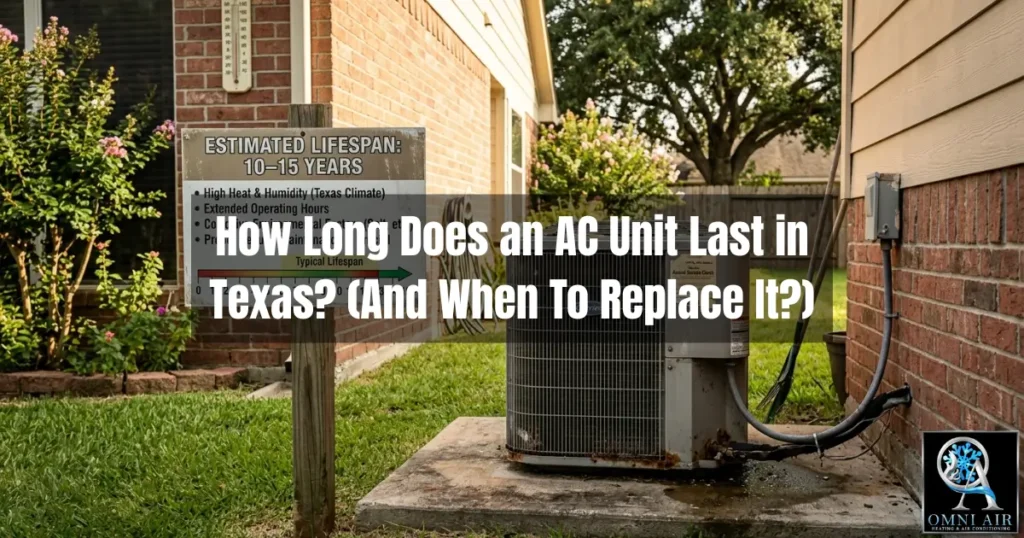
Last August I took a call from a family off Walden Road here in Montgomery. Their AC had quit on a Thursday afternoon. The homeowner told me the unit was “only about ten years old.”
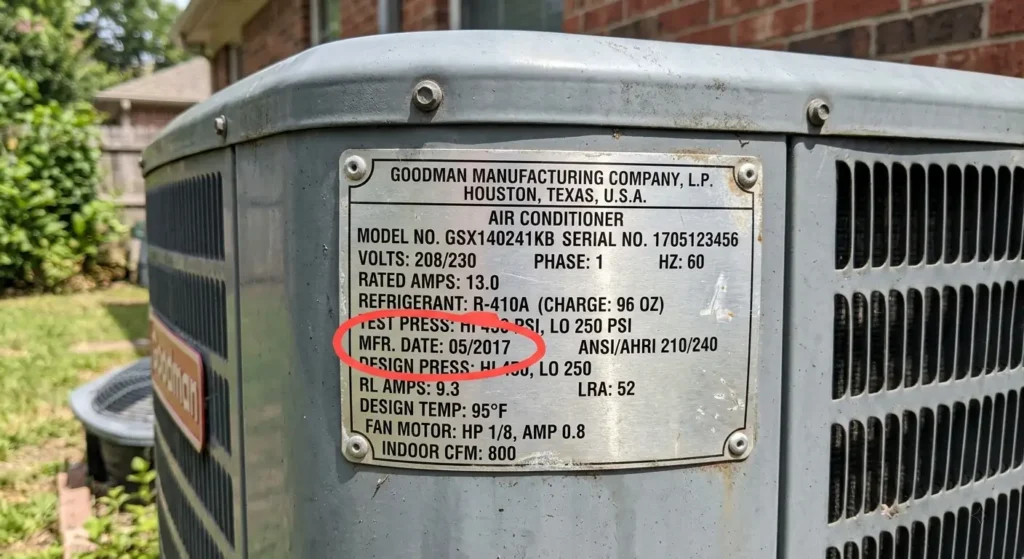
The data plate said 2011. The compressor had shorted to ground, and the coil above it had been weeping refrigerant for two summers. She was surprised, because every article she had read said air conditioners last 15 to 20 years.
Those articles are not wrong. They are just not written for Texas.
Quick answer:
How long does AC last in Texas? Most central air conditioners in Texas last 12 to 15 years. Across the residential replacements Omni Air completed in Montgomery County, the median age at replacement was 13 years. Systems with documented annual maintenance averaged close to 16 years. Systems with no service history averaged closer to 11. The national 15 to 20 year figure does not hold here, because a Texas system runs two to three times more cooling hours per year.
How Long Does an AC Last in Texas? What Our Service Records Show
I sorted every residential replacement we completed by the manufacture year stamped on the data plate, not the year the homeowner thought it went in. Those two numbers are often different.
Table 1. Age at replacement, Omni Air residential jobs, Montgomery County
| Age at Replacement | Share of Jobs |
| Under 8 years | 10% |
| 8 to 11 years | 25% |
| 12 to 15 years | 42% |
| 16 to 19 years | 20% |
| 20 years or more | 3% |
The median sits at 13 years, four years short of the number most national articles quote. Compressor failure and evaporator coil leaks were the two most common reasons across every age band. The 11 percent under eight years is not bad luck: nearly every unit in that group had an installation problem, whether oversized equipment, a bad braze joint, a line set that was never properly evacuated, or an indoor coil that never matched the outdoor unit.
Maintenance moved the number by more than four years
Table 2. Average age at replacement by service history
| Service History | Average Age at Replacement |
| Maintenance agreement, serviced twice a year | 15.3 years |
| Serviced occasionally, no agreement | 13.2 years |
| No service call on record before the failure | 11.5 years |
That 4.4 year spread is the largest single factor in our data, bigger than brand or SEER rating. We offer HVAC maintenance in Montgomery TX mainly because of what those three rows say.
Why Texas Cuts Years Off the National Average
Houston Intercontinental is the closest first-order weather station to Montgomery County. Its 1991 to 2020 climate normals put the average daily high at 86.9 in May, 92.3 in June, 94.5 in July, 94.9 in August and 90.4 in September (NWS Houston/Galveston climate normals). So a system here carries cooling load from March into November. The same model in Ohio works hard for ten weeks. Compressors, capacitors and fan motors wear by the hour, not the calendar.
Humidity is the other half. Every hour your AC runs it also pulls water from the air, leaving a permanently wet indoor coil and a drain line that never dries out. Wet metal in a hot attic corrodes, and it is worse in lakefront and near-lake homes, where all-aluminum outdoor coils are also prone to pinhole corrosion.
How I Know This: I am Joseph Miller. I run service and installation calls for Omni Air & Heating LLC out of Montgomery, Texas. The company has worked this county for more than 15 years under Texas license TACLA105873C. Most summer weeks I am in attics and side yards in Montgomery, Conroe, Willis, Bentwater and Magnolia. The tables here come from our own dispatch and invoice records. Outside figures link to the agency that published them, not a blog that repeated them.
What Actually Ends AC Units in Montgomery County
The attic, not the yard
Most homes here put the air handler and coil in the attic. On a 98 degree August afternoon a Montgomery attic sits between 125 and 140 degrees, and that is where your blower motor, control board, drain pan and coil live for nine months a year. In our records the attic side causes trouble before the outdoor unit does. A rusted secondary pan or plugged drain shows up as a water stain on the ceiling below the air handler.
Oversized equipment left over from the building boom
Montgomery County grew fast between 2005 and 2015, and much of that equipment was builder-grade 13 SEER, sized off a square-footage rule of thumb rather than a Manual J load calculation. An oversized system cools fast, satisfies the thermostat and shuts off before removing much humidity, then starts again. That short cycling is hard on the compressor. If your house cools quickly but feels clammy, sizing is usually why, and the fix is sometimes splitting the house into zones rather than a bigger unit. Wider picture in our guide to HVAC systems in Montgomery TX.
What I Got Wrong at First
1. I took the install date at face value
I once worked a house in Conroe with a system the owner called a 2019 install. The data plate said 2016. It had sat in a distributor warehouse, then gone into a spec home at a discount. Functionally it was a nine-year-old machine.
Most manufacturers encode the build week and year in the first four digits of the serial number, though Goodman, Trane, Carrier and Lennox each format it differently. Photograph the plate and any competent tech can date it in seconds. That is the number I use for every repair-or-replace conversation.
2. I topped off leaking coils instead of calling it
I used to find a small evaporator leak, add refrigerant and tell the homeowner to watch it. Wrong twice over. Adding refrigerant to a leaking system is a rental, not a repair, and past ten years a leaking coil is usually the first of several sealed-system failures. My rule now: if a system needs refrigerant twice within 24 months, I quote a leak search instead.
3. I did not ask about warranty registration
Most manufacturers give a base parts warranty of five years that extends to ten if the system is registered, usually within 60 to 90 days of installation. Registration is free and gets skipped constantly, sometimes by the installing contractor. I lost count of the homeowners who paid full retail for a compressor in year seven on a system that would have been covered. If your system is under a year old, go check today.
7 Signs Your AC Is Near the End in Texas
None of these alone means replace. Two or three together usually does.
- It runs almost constantly and still cannot hold your setting. A healthy system here holds 75 to 78 on a 98 degree day. If yours runs but never brings the temperature down, something is wrong.
- Your July bill climbed year over year while your habits did not change.
- The house hits the set temperature but still feels damp. On an older oversized system that is often unfixable without new equipment.
- Repairs are stacking. Two or more service calls in twelve months is a pattern.
- Refrigerant has been added more than once. That is a leak, not a repair.
- New noise. A grinding, screeching or banging sound at startup points at bearings or a failing compressor.
- The system keeps tripping the breaker. Repeated trips often mean a compressor drawing high amps as it fails.
Repair or Replace? The Rule I Use on Every Call
You have probably seen the $5,000 rule: multiply system age by repair cost and replace if the result clears $5,000. Fair starting point, but it ignores refrigerant type, warranty status and what actually failed. I recommend replacement when at least two of these three are true.
- It is 12 years or older by manufacture date, not install date.
- The quoted repair is more than one third of the cost of a comparable new system.
- The failure is sealed-system: compressor, condenser coil or evaporator coil.
If only one is true, repair is usually the better call and I will say so, even though replacement is the bigger invoice for us. Either way, get the diagnosis in writing, standard on every AC repair call in Montgomery TX we run.
The refrigerant rule most homeowners have not heard about
This changed the math in 2025 and most articles have not caught up. Under the EPA Technology Transitions rule, issued through the American Innovation and Manufacturing Act, manufacturers could no longer produce or import new residential AC and heat pump systems using refrigerants above 700 global warming potential as of January 1, 2025 (EPA, Technology Transitions HFC Restrictions by Sector). R-410A sits near 2,088, so new systems use R-454B or R-32. Your existing R-410A system is still legal to run, service and recharge. Two things follow anyway.
- R-410A production shrinks every year, so the refrigerant line on a repair invoice keeps climbing. Older R-22 systems, whose refrigerant stopped being produced in 2020 (EPA), are worse still. At reclaimed pricing I have not justified a sealed-system repair on one in years.
- If the outdoor unit and indoor coil both need replacing at once, EPA treats that as a new system, so the lower-GWP refrigerant applies. A double failure on an R-410A system is a full replacement whether you planned it or not.
Ask one question before accepting a coil-only replacement
Ask for the AHRI certified match. A new coil paired with an old condenser never rated with it will not deliver either part’s published performance, and a mismatch can void the coil warranty. AHRI notes that regional standards are “enforced by the date of installation,” and Texas sits in the Southeast region, where split systems under 45,000 BTU must meet 14.3 SEER2 (AHRI).
One Replacement, Before and After
A Bentwater homeowner called in September 2025 about a 2011 builder-installed system: 4 tons, 13 SEER, air handler in the attic. The compressor failed at year 14 and the original coil showed corrosion at the return bends. Two triggers were met, so it became a full replacement.
Table 3. Bentwater replacement, before and after
| Measure | Old System (2011) | New System (2025) |
| Rated efficiency | 13 SEER | 15.2 SEER2 |
| Refrigerant | R-410A | R-454B |
| July cooling kWh, weather-normalized | 2,310 kWh | 1,585 kWh |
| Indoor humidity, July afternoon | 57 to 63% | 48 to 52% |
The kWh figures are normalized against cooling degree days, so we are not comparing a mild July to a brutal one. The humidity drop mattered more to that family than the bill did. If you are comparing equipment types, our heat pump versus central AC comparison walks through the trade-offs.
How to Get 15 Years or More Out of an AC in Texas
- Service it twice a year, spring and fall. Our data says that is worth roughly four years of equipment life.
- Change the filter on a schedule, not when it looks dirty. Every 60 to 90 days for a one-inch filter, more often with pets.
- Keep two feet clear around the condenser and rinse the coil from the inside out with a garden hose, power off at the disconnect. Never a pressure washer.
- Treat the condensate drain before it backs up. A plugged drain in an attic ends with drywall on the floor.
- Register the warranty within 90 days.
When it is time, insist on a load calculation. Replacing a four-ton unit with a four-ton unit because that is what was there is how oversizing gets inherited. Every AC installation we do in Montgomery TX starts with a Manual J, and we show you the math.
Why Choose Omni Air & Heating LLC for HVAC Solutions
- Local and licensed. We work out of Montgomery under Texas license TACLA105873C, with more than 15 years serving Montgomery, Conroe, Willis, Bentwater, Shenandoah, Spring and Magnolia. Not a franchise routing calls from another metro.
- We will tell you to repair. The three-part rule above is what our techs use in your driveway. When only one condition is met, we quote the repair.
- Honest hours. Monday to Friday, 8:00 to 5:00. We do not advertise 24/7 service we cannot staff. Call early and we will try for same day.
- Sizing before selling. Manual J on every replacement and an AHRI certified match on every install.
- Financing without the runaround. A failed compressor in August is not a planned expense. Our HVAC financing options let you spread it out.
Frequently Asked Questions
How long does an AC last in Texas?
Most central air conditioners in Texas last 12 to 15 years. In our Montgomery County records the median at replacement was 13 years. Well-maintained systems commonly reach 16 to 18, while systems that never get serviced often fail between years 9 and 11. Texas equipment runs far more cooling hours than northern equipment, which is why the national 15 to 20 year estimate does not apply here.
Is it worth repairing a 15-year-old AC unit in Texas?
Usually not, if the failure is a sealed-system part such as the compressor or either coil. At 15 years a repair costing more than a third of a new system rarely pays back, because the surrounding parts are the same age and the warranty is expired. A failed capacitor or contactor is different and worth fixing.
Does the R-410A phase-out mean I have to replace my AC?
No. Existing R-410A systems remain legal to operate, service and recharge. The EPA rule effective January 1, 2025 restricts manufacture and import of new residential equipment using refrigerants above 700 GWP. What changes is cost, since shrinking R-410A production makes recharges pricier each year. If the outdoor unit and indoor coil both need replacing at once, that counts as a new system and must use the lower-GWP refrigerant.
Final Thoughts
If you take one thing from this, make it the manufacture date. Find the data plate on your condenser and write down the serial number. That turns a vague worry into a decision you can plan around.
Twelve years is when I start the conversation. Fifteen is when I expect it. Somewhere in between a repair quote will land in front of you, and the answer depends on the manufacture date, the refrigerant, what failed, and whether anyone has maintained the system.
If you want a straight answer about your system, Omni Air & Heating LLC will look at it and put the diagnosis in writing. We serve Montgomery, Conroe, Willis, Bentwater, The Woodlands and surrounding communities.
- Air Duct Cleaning Montgomery TX: Do You Actually Need It?
- Mold and Your HVAC System: What Montgomery TX Homeowners Need to Know
- HVAC Tips for New Homeowners in The Woodlands TX: A Tech’s First-Year Plan
- AC Allergens: How to Reduce Pollen and Dust in Your Texas Home
- HVAC Maintenance Checklist for Montgomery TX Homeowners: Spring & Fall Tune-Up

Joseph Miller is the owner and lead Heating & Air Conditioning Specialist at Omni Air & Heating LLC, proudly serving Montgomery, Texas and surrounding communities since 2020. Joseph brings hands-on experience diagnosing, repairing, and installing residential and light commercial heating and cooling systems. His expertise includes air conditioning systems, heat pumps, furnace repair, system replacements, ductless mini splits, and indoor air quality solutions designed for the unique climate conditions of Southeast Texas.
0 Comments