
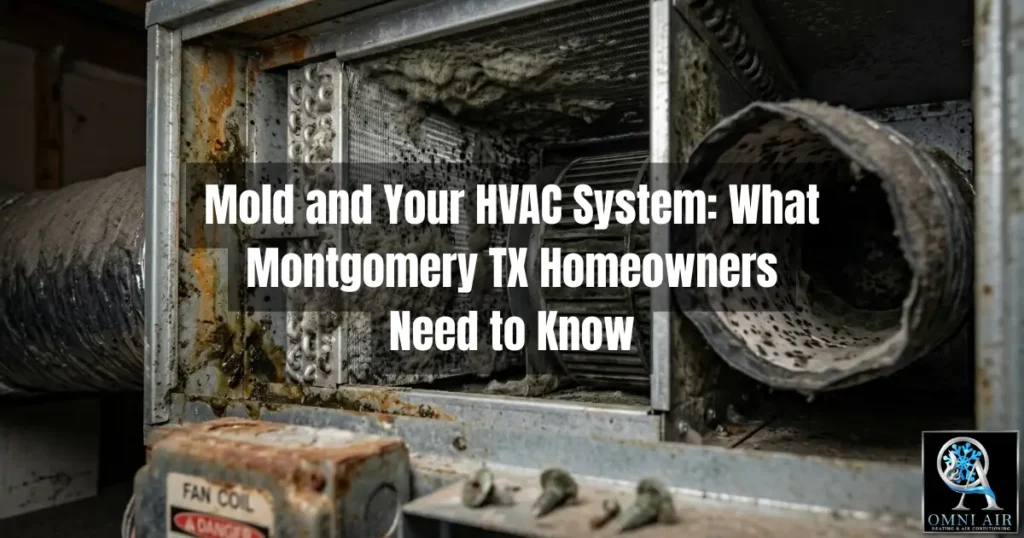
Most mold calls I get do not start with the word mold. They start with “my house smells like a wet towel when the AC kicks on.” Sometimes the homeowner has already pulled a vent cover, seen black specks, and spent a night reading scary things online.
I service air conditioners across Montgomery County, and I have had my head inside a lot of musty air handlers. Here is what I tell people at the door: mold in an HVAC system is a water problem first and a cleaning problem second. If nobody finds the water, the cleaning does not last.
Below I cover where the growth really sits, how I tell mold from plain dirt, what Texas law says about who can clean it, and the mistakes I made before I learned to work in that order.
How I know this: I am a licensed HVAC technician with Omni Air & Heating LLC (Texas license TACLA105873C). I run musty-smell and humidity calls every cooling season in Montgomery, Conroe, Willis, The Woodlands, and the Lake Conroe communities. The process, the mistakes, and the case notes below come from those calls. Where I quote a number from a government or research source, I link to the original.
Quick Answer: Mold grows in an HVAC system when dust stays wet. In Montgomery, TX homes that usually means the evaporator coil, the drain pan, or damp insulation next to the coil, not the full run of ductwork. The fix has three parts: stop the moisture, clean or replace the wet parts, and hold indoor humidity under 50 percent. In Texas, hired cleanup of visible mold covering 25 contiguous square feet or more must be done by a TDLR-licensed mold remediation contractor.
First, Is It Actually Mold? How I Sort It Out
About half the “mold” I am shown is something else. Dust streaks on a vent cover, rust on a coil, and soot from candles all look alarming under a phone flashlight. The EPA’s duct cleaning guide makes the same point: only an expert can make a positive call, and it may take a lab to confirm it.
So I start with timing and smell before I start with looks. I stand at a supply vent, have the homeowner drop the thermostat, and pay attention to the first two minutes.
- Smell hits hard at startup, then fades. The source is almost always at the coil, the drain pan, or the insulation right beside them. Those parts sat wet while the system was off.
- Smell stays the whole cycle. I look past the air handler: a damp duct, a wet return box, or a humidity problem in the house itself.
- No smell, just dark spots on one or two vents. That is usually condensation on a cold metal register catching dust. It is a humidity clue, not proof the ducts are moldy.
Here is the chart I walk through on a call.
| What you Notice | Most likely source | What I check first |
| Musty smell for the first minute or two, then it fades | Wet coil, drain pan, or insulation near the coil | Coil face, water level in the pan, drain line flow |
| Musty smell the whole time the system runs | Damp duct, wet return plenum, or high humidity in the house | Return side, attic ducts, indoor humidity reading |
| Dark specks on one or two supply vents | Condensation on a cold register holding dust | Register surface temperature against the room dew point, boot insulation |
| Gray or black dust on every vent and on the filter | Household dust or soot, sometimes duct liner breaking down | Filter fit, return leaks, candle and fireplace use |
| Fuzzy growth on the filter itself | The filter is getting wet | Filter location, pan overflow, humidity |
| Water stain on the ceiling near the attic unit | Drain pan overflowing | Primary drain, secondary pan, float switch |
If you have that last one, the mold question can wait a day. The leak cannot. I wrote about that failure in our guide on what it means when your AC is leaking water.
Mold in HVAC System Montgomery Homes: Where I Actually Find It
People picture mold coating the inside of every duct. That is rare. When I went back through my musty-smell tickets from this past cooling season, 15 of 30 calls traced to the coil, the pan, or the insulation beside them. Only 5 calls had growth running through the ducts. Here are the five places I check, in the order I check them.
1. The Evaporator Coil and Drain Pan
The indoor coil is built to get wet. On a humid day it pulls water out of the air all afternoon. Any dust that slips past the filter sticks to those wet fins, and that dust is food. The pan under the coil collects the water, and when the drain line slows down, the pan turns into a shallow pond with a slime layer on it.
This is the spot the EPA singles out too. Its guide tells homeowners to keep drip pans clean and drain lines flowing. I find a slow drain on most musty-smell calls.
2. Insulation Inside the Air Handler Cabinet
The cabinet around the coil is lined with fiberglass insulation. If water splashes off the coil or the pan overflows, that liner soaks it up and stays damp for days. You cannot scrub fiberglass clean. The EPA is blunt about wet or moldy duct insulation: “it cannot be effectively cleaned and should be removed and replaced.”
3. Flex Duct and Duct Board in the Attic
Most homes I work on here have flex duct running through the attic, and many older ones have duct board plenums. Both are porous on the inside. They get wet in two ways. A torn or crushed insulation jacket lets hot attic air touch the cold inner liner, and it sweats. Or a loose connection pulls damp attic air straight into the airstream. When I find growth inside flex duct, I replace that section. It costs less than trying to clean it, and cleaning it does not hold. If several runs are wet, that becomes a ductwork repair or replacement job.
4. Supply Registers and Boots
Dark spotting on the vent cover or the ceiling around it is the thing homeowners see first. The cause is simple. Cold air makes the metal register colder than the dew point of the room, water beads on it, and dust sticks. Wipe it with detergent and water, dry it, and then ask why the room air is that damp.
5. The Return Side
A return duct with a gap in an attic or garage pulls in hot, wet, unfiltered air on every cycle. That air skips the filter and lands on the coil. I check the filter slot too. A filter that is the wrong size leaves a gap, and the dust that goes around it feeds whatever is growing downstream.
Why Montgomery County Systems Grow Mold: The Local Angle
The Department of Energy’s Building America climate guide puts East Texas in the hot-humid zone. In practice, that means your AC has two jobs here for most of the year: cooling the air and drying it. Mold shows up when the second job is not getting done. These are the reasons I see most.
- The unit is too big for the house. An oversized system cools the house fast and shuts off before it has removed much moisture. The EPA warns that a unit that is too big will cycle on and off often and remove moisture poorly in humid areas. I see this in homes where a past replacement “went up a size to be safe.”
- The fan is set to ON instead of AUTO. This one surprises people. When the compressor stops and the fan keeps blowing, the water sitting on the coil goes right back into the house. Researchers at the Florida Solar Energy Center measured this effect and described it plainly: moisture on the coil “evaporates back into air stream when the coil is off.”
- The thermostat is set very low. Holding 68 degrees in August makes ducts and registers cold enough to sweat in the attic and at the ceiling.
- The house sits empty. Weekend places around the lake get set to 85 or shut off. The AC barely runs, so nothing dries the air.
- The power was out for days. The EPA says wet materials need to dry within 24 to 48 hours to prevent growth. After a long summer outage, a closed-up house blows past that window.
A Real Call: Musty Smell at a Lake Conroe Home, Before and After
This one is typical enough to share. A homeowner near the lake called because the house smelled sour every time the AC started. A duct cleaning company had already quoted a full cleaning plus a fogging treatment.
I spent the first 20 minutes measuring, not cleaning. The thermostat fan was set to ON. The filter was an inch narrower than its slot. The drain pan was holding water, and the coil face was matted with dust. The first few feet of flex duct off the supply plenum were damp inside. The rest of the ducts were dusty but dry.
We cleaned the coil and pan, cleared the drain line, replaced the wet section of flex duct, fitted the right filter, and switched the fan to AUTO. I came back two weeks later with the same meter.
| Measurement | First Visit | Two weeks after repair |
| Indoor relative humidity at 75°F | 70% | 52% |
| Indoor dew point (calculated from the readings above) | About 64°F | About 56°F |
| Drain pan | Standing water, slime layer | Dry between cycles, drain flowing |
| Thermostat fan setting | ON | AUTO |
| Filter fit | About 1 inch gap at the side | Correct size, no gap |
| Odor at startup | Strong, every cycle | None reported |
| Duct replaced | None | About 5 feet of flex at the plenum |
No fogging. No whole-house duct cleaning. The smell was coming from about six feet of the system, and the humidity was coming from a switch on the wall.
Three Things Most Mold Articles Skip
I read the pages that rank for this topic before writing mine. They list the same signs and tell you to call a pro. These are the parts I think they leave out.
Your Duct Material Decides Whether Cleaning Is Even Possible
Bare sheet metal can be cleaned. Flex duct, duct board, and fiberglass-lined metal cannot be cleaned well once they are moldy. Since most houses here have flex duct, the honest answer is often “replace this section,” not “clean the whole system.” Ask anyone quoting you a cleaning what your ducts are made of. If they do not know, that tells you something.
Sprays and Fogging Are Not a Fix
According to the EPA, no biocide products are registered for use on fiberglass duct board or fiberglass-lined ducts. Fogging a porous duct leaves the dead growth in place and adds a chemical to the air you breathe. The agency also does not recommend routine duct cleaning at all, only cleaning when there is a specific need.
You Probably Do Not Need a Mold Test
People ask me which kind of mold they have. For the repair, it does not matter. The CDC says it directly: “CDC does not recommend mold testing.” Whatever type it is, the response is the same. Remove it and fix the moisture. A lab check of a tape sample is worth it when you need to prove whether a substance is mold at all, such as before a large repair bill or a home sale.
What I Got Wrong at First
I was not always good at these calls. Four mistakes changed how I work.
I cleaned the coil and left the cause. Early on I would wash a slimy coil, clear the drain, and drive off. One homeowner called back about 4 weeks later with the same smell. The system was oversized and the fan was on ON. I had cleaned the symptom. Now I do not close a mold-related ticket without an indoor humidity reading and a drain test.
I sold a UV light as the answer. UV lights do help keep the coil surface cleaner, and I still install them. But a light does not dry a wet pan, and it does not reach inside the ducts. I put one in a system with a slow drain once, and the pan was slimy again by the next summer. I go through the limits in our post on UV light air purifiers for HVAC.
I called it mold without proof. I once told a family their vents were moldy. It was soot from candles they burned every night. Now I say “suspected growth,” show photos, and suggest a lab check when the answer changes what we do next.
I told someone to run the fan all the time. I thought moving more air would clear the smell. It pushed coil moisture back into the house and made the humidity worse. That advice works in a dry climate. It does not work here.
What You Can Safely Do Yourself, and the Hard Stop
You can handle a good share of prevention on your own.
- Buy a humidity meter. They are inexpensive at any hardware store. Put it in a hallway, away from the kitchen and bathrooms. The EPA’s mold guide says to keep indoor humidity below 60 percent, ideally between 30 and 50.
- Set the thermostat fan to AUTO during cooling season.
- Use the right filter and change it on time. It should fill the slot with no gaps.
- Watch the drain line. On a humid day with the AC running, the line outside should drip steadily. If it is dry, or water is coming from the pipe above a window, call for service.
- Clean vent covers with detergent and water, then dry them fully.
Then the hard stop. Do not spray bleach, vinegar, or a fogger into your ducts. Do not open the coil compartment, because refrigerant lines and live electrical parts are in there. And if you see heavy growth inside the air handler, turn the system off and call. The EPA advises against running a system you know or suspect is contaminated, because it can spread mold through the house. One more thing I am careful about: I am an HVAC tech, not a doctor. If anyone at home has asthma or breathing symptoms, that is a question for their physician. For the dust and pollen side of indoor air, see our post on allergens and your AC.
Who Is Allowed to Clean It? The Texas 25-Square-Foot Rule
This is the part I almost never see explained, and it matters when you are comparing quotes. Texas licenses mold work through the Texas Department of Licensing and Regulation (TDLR). The line is drawn by size.
- Small areas. In its consumer mold guide, TDLR says visible mold “less than 25 contiguous square feet” can, in most cases, be cleaned by someone without a mold license. A homeowner can also clean mold in their own home.
- Large areas. Hired cleanup of 25 contiguous square feet or more calls for a TDLR-licensed mold remediation contractor, working from a written plan by a licensed mold assessor.
- Two separate companies. On a licensed project, the assessor and the remediator cannot be the same company. That keeps the person measuring the problem from profiting on the size of it.
- HVAC has its own section. 16 Texas Administrative Code §78.130 covers mold remediation in HVAC systems, and it confirms that repair or service of the equipment itself requires a state air conditioning contractor license.
So here is how I split the work. Finding the moisture, repairing the equipment, cleaning the coil and pan, and replacing wet duct are HVAC jobs, and those are mine. If I open a system and find growth past that 25-square-foot mark, or mold that has moved into drywall or framing, I stop and tell you to bring in a licensed assessor.
A Mold Prevention Schedule for Montgomery County Homes
| When | What to do | Who does it |
| March to April | Clean the coil and drain pan, flush the drain line, test the float switch, check filter fit | Technician, during a spring tune-up |
| May to September | Check the humidity meter weekly, check the filter monthly, confirm the drain line is dripping | Homeowner |
| After any leak or long outage | Dry wet areas within 24 to 48 hours, then have the air handler and nearby ducts inspected | Homeowner first, then technician |
| October to November | Inspect attic ducts for torn jackets, sagging, and loose collars while the attic is cooler | Technician, during a fall tune-up |
| When you are away | Leave the system running on AUTO. Do not shut it off. If your thermostat has a humidity setting, use it | Homeowner |
The spring and fall items line up with our HVAC maintenance checklist, and they are part of a regular HVAC maintenance visit. For a lake house or a rental you do not see every week, a thermostat that reports humidity to your phone is worth the money. We compare options in our post on smart thermostats.
Why Choose Omni Air & Heating LLC for HVAC Solutions
Plenty of companies will sell you a duct cleaning. Here is how Omni Air & Heating LLC handle a mold or musty-smell call, and why homeowners around Montgomery keep our number.
- We find the water first. Every visit starts with a humidity reading, a drain test, and a look at the coil. You get the cause, not only a cleaning quote.
- We show you what we see. The EPA tells homeowners to ask the provider to show them any mold they claim is there. You will get photos from inside your own system.
- We only replace what is wet. If six feet of duct is the problem, you get a price for six feet.
- We stay inside our license. We hold Texas air conditioning contractor license TACLA105873C and have more than 15 years in the trade. When a job belongs to a licensed mold assessor or remediator, we say so.
- We know these houses. Attic air handlers, flex duct, lake humidity, and weekend homes are what we work on every day, from Conroe and Willis to The Woodlands, Magnolia, Bentwater, and Walden.
- Straight pricing and financing options, Monday through Friday, 8 to 5.
If the fix involves humidity control, filtration, or a UV light, that falls under our indoor air quality services.
Frequently Asked Questions
How do I know if there is mold in my HVAC system?
The most common sign is a musty smell that shows up when the system starts. Other signs are fuzzy or slimy growth on the coil, drain pan, or filter, and dark spotting around supply vents. Looks can fool you, so ask the technician to show you photos of what they found before you pay for cleaning.
Is mold in an HVAC system dangerous?
It can be, depending on the person. The CDC says mold can cause a stuffy nose, coughing, wheezing, burning eyes, or a skin rash, and that people with asthma, mold allergies, weak immune systems, or chronic lung disease can react more strongly. If someone in the home has symptoms, talk to a doctor.
Can I clean mold out of my air ducts myself?
You can wipe mold spots off metal vent covers with detergent and water and dry them. Do not spray bleach or foggers into the ducts. Most Montgomery County homes have flex duct or duct board, which is porous. The EPA says wet or moldy duct insulation cannot be cleaned well and should be replaced.
Does a UV light kill mold in an HVAC system?
A UV light helps keep growth off the coil surface it shines on. It does not dry a wet drain pan, lower humidity, or reach inside the ducts. Treat it as an add-on after the moisture problem is fixed, not as the fix.
Do I need a mold test before fixing my HVAC system?
Usually not. The CDC does not recommend routine mold testing, because the response is the same for any type: remove it and fix the moisture. A lab check of a tape sample makes sense when you need proof that a substance is mold, such as before a large repair or a home sale.
Who removes mold from an HVAC system in Texas?
A licensed air conditioning contractor fixes the moisture source and cleans or replaces HVAC parts. When visible mold covers 25 contiguous square feet or more and you hire the cleanup out, Texas requires a mold remediation contractor licensed by TDLR, working from a plan written by a separate licensed mold assessor.
What humidity level stops mold in a Texas home?
Keep indoor humidity under 50 percent when you can. The CDC and TDLR both say no higher than 50 percent, and the EPA says below 60 percent with 30 to 50 percent as the ideal range. A small humidity meter placed in a hallway will tell you where your home sits.
Final Thoughts
Mold in an HVAC system looks like a cleaning job, but it starts as a moisture problem. In our climate the AC has to dry the air as well as cool it, and growth shows up where that is not happening: a slow drain, a wet coil, a sweating duct, a fan left on ON. Find that, fix it, replace what cannot be cleaned, and keep an eye on a ten-dollar humidity meter.
If your house smells musty when the system starts, or you have found something on a vent you are not sure about, call us at (281) 767-6664. I would sooner look at it in October than in the middle of July.
Recent Articles:
- Air Duct Cleaning Montgomery TX: Do You Actually Need It?
- Mold and Your HVAC System: What Montgomery TX Homeowners Need to Know
- HVAC Tips for New Homeowners in The Woodlands TX: A Tech’s First-Year Plan
- AC Allergens: How to Reduce Pollen and Dust in Your Texas Home
- HVAC Maintenance Checklist for Montgomery TX Homeowners: Spring & Fall Tune-Up

Joseph Miller is the owner and lead Heating & Air Conditioning Specialist at Omni Air & Heating LLC, proudly serving Montgomery, Texas and surrounding communities since 2020. Joseph brings hands-on experience diagnosing, repairing, and installing residential and light commercial heating and cooling systems. His expertise includes air conditioning systems, heat pumps, furnace repair, system replacements, ductless mini splits, and indoor air quality solutions designed for the unique climate conditions of Southeast Texas.
0 Comments