
The first hot week of the year is when my phone starts ringing about noise. A homeowner turns the thermostat down for the first time since fall, the system kicks on, and instead of the usual quiet hum they hear a bang, a groan, or a buzz that makes them jump. I run service calls across Montgomery County, and I have opened up hundreds of units that were noisy at startup.
Here is the short version: most of these sounds are your system warning you before something bigger breaks. The trick is not to guess. Below I will explain what each sound means, what you can safely check yourself, and when to call. I will also share a few things I got wrong early on, since those mistakes are the fastest way to learn what actually works.
How I know this: I am a licensed HVAC technician and I diagnose startup-noise complaints every cooling season across Montgomery, Conroe, Willis, The Woodlands, and the nearby towns. The examples below come from real calls I have run in this area, not from a parts catalog. Omni Air & Heating LLC holds Texas license number TACLA105873C.
First, Is the Noise Actually a Problem? The Two-Second Test
Every AC makes some sound when it starts. You should hear a soft click as the contactor closes, a low hum as the compressor and fan spin up, then air moving through the vents. That is normal. What is not normal is a sound loud enough to notice from inside the house, or one that keeps going instead of settling down.
Here is the test I run on every call. I listen to the first two seconds, because most startup problems announce themselves the moment the system energizes. Then I ask two questions:
- Does the loud noise happen only at startup, then fade? That points to the electrical and starting parts, mostly the capacitor and the compressor.
- Does it start at startup and keep going the whole cycle? That points to something mechanical that is spinning, like a fan blade or a worn bearing.
Sorting the noise by when it happens narrows the cause faster than sorting it by what it sounds like. Most guides only list sounds. Timing is the first thing I do, and it is the difference between a quick diagnosis and an hour of guessing.
7 Causes I See Most when AC Making Loud Noise When Starting in Montgomery Homes
These are the causes I run into on real calls, roughly in order of how often I find them, with honest notes on what you can safely do and what needs a tech.
1. Weak Run Capacitor (the number one startup-noise call I run)
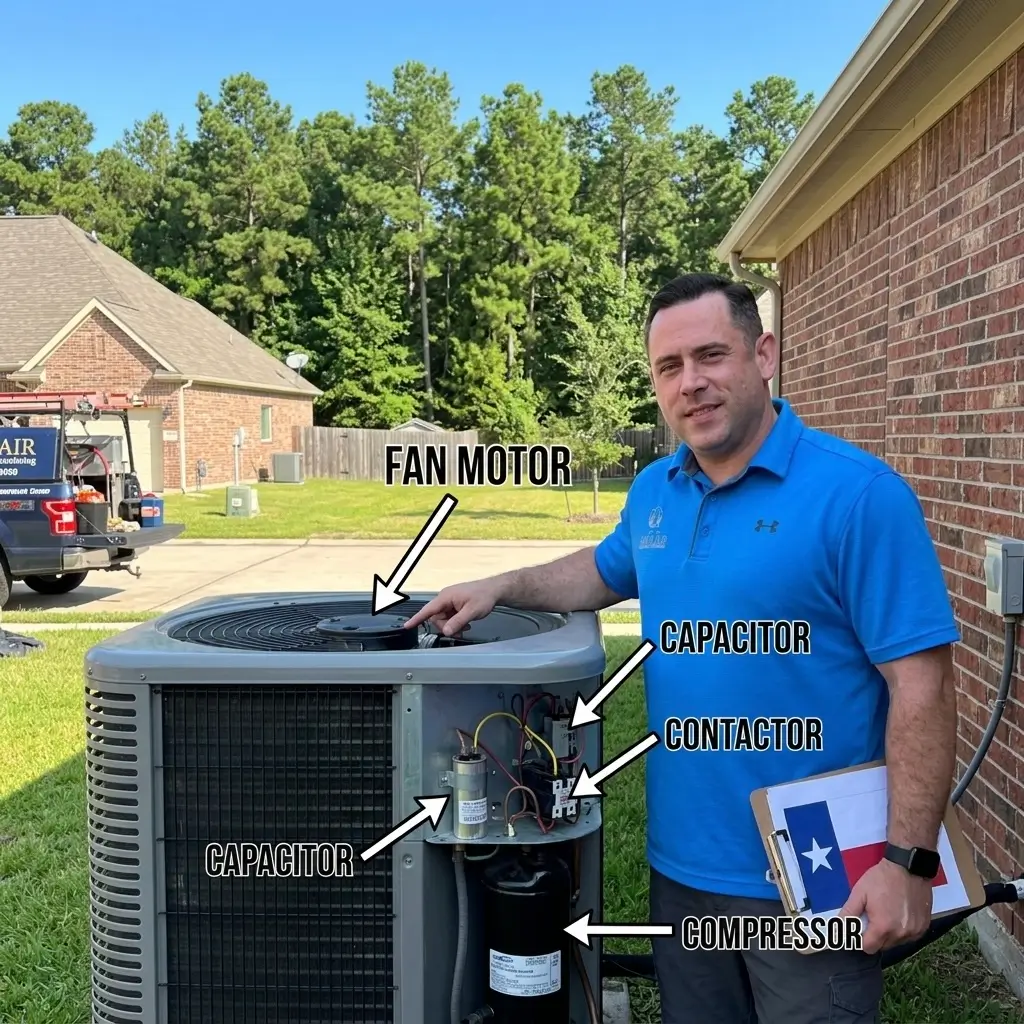
The capacitor is a small cylinder that gives the compressor and fan motor the jolt they need to start turning. When it weakens, the compressor has to fight to get going, and that fight is loud. It usually sounds like a deep hum or a groan for a few seconds, sometimes with a hard clunk, then the system either catches or shuts off.
I pull more weak capacitors than any other part. One that tested fine in April can drop below spec by July, because our heat is hard on them. I meter it and compare the reading to the rating printed on the side. If a 45-microfarad capacitor reads 32, it is on its way out, and the compressor strains every time it starts.
Fix: This is a part replacement, not a do-it-yourself job. A capacitor holds a charge even after the power is off, and it can hurt you. That is a hard stop for homeowners. The upside is it is a cheaper repair, and catching it early is the difference between a small part and a burned-out compressor.
2. Chattering Contactor
The contactor is the switch that sends power to the outdoor unit when the thermostat calls for cooling. When its contacts get pitted, or an ant crawls in and dies across them (which happens more than you would think in Texas), it does not close cleanly. Instead of one clean click you get a rapid buzzing or chattering at startup, almost like a rattlesnake.
I have opened up more than one contactor with a fried ant colony inside.
Fix: A contactor is a straightforward replacement for a tech, and it is worth checking the capacitor at the same time, since the two often wear out together.
3. Compressor That Is Hard-Starting or Failing
If the capacitor tests fine and the compressor still groans, strains, and then the breaker trips, the compressor itself may be struggling to start under its own load. A healthy compressor starts smoothly. One that groans loudly, pulls too much power, and pops the breaker is getting weak, or fighting low voltage.
If your system also keeps shutting itself off, that overlaps with an AC that trips the breaker, and a loud hard-start and a tripping breaker often show up together. Sometimes the fix is a hard-start kit, which gives the compressor extra starting torque. A failing compressor, though, is the most expensive part in the system, and on an older unit it is usually the moment we talk about replacement instead of repair.
4. A Loose or Bent Fan Blade, or Debris in the Unit
This is the bang and clang most articles lead with. It is real, just not the most common startup cause I see. The outdoor unit pulls in sticks, acorns, and once a tennis ball. When the fan hits debris, or a bent blade clips the housing, you get a loud bang right at startup.
Fix: This one has a safe homeowner step. Turn the system off at the thermostat and at the outdoor disconnect, look down through the top grille, and clear out any leaves or twigs you can reach. If a blade is bent or a motor mount is loose, that is a tech repair.
5. Fan Motor Bearings Wearing Out
A high, metal-on-metal screech, or a grinding that starts when the fan spins up and keeps going, usually means the fan motor bearings are worn. Older motors had oil ports you could lubricate. Most motors today are sealed, so once the bearings go, the fix is a new motor, not a squirt of oil. I got this one wrong early on, and I will own it in the mistakes section below.
6. Refrigerant and Metering Device Noise
A hiss or a short high-pitched scream at startup can come from refrigerant moving through the metering device as pressures equalize. A brief hiss can be normal. A loud, sustained hiss or a bubbling sound can point to a refrigerant problem or a failing expansion valve, and that needs a gauge set to diagnose, not a guess.
There is a timing angle here too. Older Montgomery systems still run on R-410A refrigerant, which is being phased down, while new systems use R-454B. If you have an older unit making refrigerant noise, it is worth knowing where the refrigerant changeover stands before you sink money into a big repair.
7. The Bang That Is Not the Unit at All
This is the one almost nobody writes about, and I catch it a few times every summer. Sometimes the loud noise at startup is not a broken part. It is the sudden pressure or temperature change traveling through the house: a refrigerant line ticks as it warms, metal ductwork expands and pops, or a settled concrete pad lets the unit rock when the compressor kicks in.
I have driven to a house sure I would find a dying compressor and instead found a loose return duct banging every time the blower started. If your “AC noise” is really a bang from the attic or the walls, your ductwork may be the real culprit, not the air conditioner.
The Texas Angle: Why Startup Noise Spikes in a Montgomery County Summer
Here is the part specific to where you live, and the piece national articles skip. Startup noise gets worse in a Montgomery County summer for reasons that have nothing to do with your unit being junk.
Capacitors hate heat. When the outdoor cabinet is baking at 130 degrees on an August afternoon, a marginal capacitor that would limp along in a mild climate fails faster here. That is why I pull so many in July and August and so few in spring.
Then there is voltage. On the hottest days, when the whole neighborhood is running AC and the grid is strained, incoming voltage can sag. A compressor already leaning on a weak capacitor may not have enough to start cleanly, so it groans and gets loud. Owners think their unit suddenly got noisy on the worst day of the year. It did not suddenly break. The heat and the low voltage exposed a part that was already on the edge. For the bigger picture, see our complete guide to HVAC systems in Montgomery TX.
Humidity matters too. Our long, wet summers mean longer cooling cycles to pull moisture from the air, so parts see more starts and more run hours than in a dry climate, which wears the starting components faster. If your AC is running but never cooling the house down on top of the noise, the long run times and the noise are often the same story.
What I Got Wrong at First (So You Do Not Have To Guess)
I have been doing this a long time, but I did not start out good at it. A few honest misses:
I used to chase the contactor first. When a unit buzzed at startup, I would swap the contactor because the buzzing was so obvious. Half the time the real problem was a weak capacitor, and I was back a week later. Now I meter the capacitor on every noise call before I touch anything else.
I ignored a hard-start groan once. On an older unit I heard the compressor groan, decided it “still worked,” and moved on. That homeowner called back a month later with a dead compressor. A groaning hard-start is a warning, and a cheap hard-start kit or a fresh capacitor at that moment can save the most expensive part in the system.
I reached for oil when I should have reached for a motor. I once tried to fix a screech by lubricating a motor that was sealed and already done. It quieted for a day and came back worse. Worn bearings on a modern sealed motor mean a new motor. The lesson in all three: startup noise is a symptom, not a diagnosis. Metering and listening in the right order finds it.
What You Can Safely Do Yourself (and the Hard Stop)
A few things a homeowner can do before calling anyone:
- Check or change the air filter. A clogged filter makes the blower work harder and can add a strained hum. According to ENERGY STAR, airflow problems can cut a system’s efficiency by up to 15 percent, so this small step matters.
- Clear debris from the outdoor unit. Power off first. Pull out leaves and sticks, and keep at least two feet of clear space around the condenser, which is what the U.S. Department of Energy recommends for proper airflow.
- Tighten any obviously loose panel or screw on the cabinet, which can rattle at startup.
Then there is the hard stop. Do not open the electrical compartment, do not touch the capacitor, and do not attempt refrigerant work. The capacitor can shock you even with the power off, and refrigerant needs a licensed tech. Staying ahead of the simple items with regular HVAC maintenance prevents most of the noise calls I run in the first place.
When to Call a Pro (and What a Real Diagnostic Looks Like)
Call a tech when the noise is loud, when it keeps happening, when the breaker trips, or when you hear grinding, sustained hissing, or a hard groan. Do not run a unit that bangs or grinds, because you can turn a small repair into a big one in a single afternoon.
When I show up for a startup-noise call, I listen to a full startup with you so I hear the exact sound, then time it, startup-only or continuous. I check the disconnect and incoming voltage, meter the capacitor against its rating, inspect the contactor and fan blade, and check refrigerant pressures if the sound points that way. That order is what keeps me from guessing. If it turns out you need AC repair, you will know exactly what part and why before I do anything.
Why Choose Omni Air & Heating LLC for Your HVAC Needs
Omni Air & Heating LLC is a local, licensed HVAC company based in Montgomery, Texas (license number TACLA105873C), and I have spent years running these exact calls across Montgomery County. Here is what that means for you:
- Local techs who know Montgomery County homes, our heat, and our humidity, from Conroe and Willis to The Woodlands, Magnolia, and the lake communities.
- Honest diagnosis. We meter and inspect before we quote, so you are not paying for a guessed part.
- Straight pricing and financing options, with no pressure to replace when a repair will do.
- Regular business hours, Monday through Friday, and we do our best to reach noise calls quickly, before a small part takes out a big one.
If your AC is making a loud noise when starting, you do not have to figure out which sound means what. That is our job.

Frequently Asked Questions
Is it normal for my AC to make a loud noise when it starts?
A soft click and a low hum are normal. A loud bang, groan, screech, grinding, or rapid buzzing is not. Those sounds usually mean a starting part, most often the capacitor, or a mechanical part like the fan is wearing out.
What is the most common cause of AC noise at startup?
In my experience across Montgomery County, a weak run capacitor is the most common cause. It makes the compressor strain to start, which comes out as a hum or a groan for a few seconds. It is a common, and usually affordable, early fix.
Can I fix a loud AC myself?
You can safely change the filter, clear debris from the outdoor unit with the power off, and tighten loose panels. Do not open the electrical compartment or touch the capacitor, which holds a dangerous charge, and refrigerant work requires a licensed tech.
Why did my AC suddenly get loud on the hottest day of the year?
Heat and grid strain expose parts that were already marginal. A capacitor weakened by heat, plus sagging voltage when the whole neighborhood runs AC, can make a compressor struggle to start and get loud. The part was likely on its way out before that day.
My AC makes a loud humming noise but still cools. Should I worry?
Yes, do not ignore it. A loud hum at startup often means a weak capacitor or a hard-starting compressor. It may still cool for now, but running it that way can burn out the compressor, the most expensive part in the system.
How much does it cost to fix a noisy AC?
It depends on the part. A capacitor or contactor is on the lower end, a fan motor is mid-range, and a compressor is the high end and often prompts a replacement conversation on older units. A proper diagnosis tells you which one you are dealing with.
Final Thoughts
An AC making a loud noise when starting is your system talking to you. Most of the time it is a small starting part, caught early, before it takes out something big. The trick is not to guess. Listen to when the noise happens, do the safe basics, and get a tech to meter the parts a homeowner should not touch. Here in Montgomery County, where the heat is hard on equipment, catching a groan or a buzz in June is a lot cheaper than replacing a compressor in August.
If you are hearing something that does not sound right, Omni Air & Heating LLC is a call away at (281) 767-6664.
- HVAC Maintenance Checklist for Montgomery TX Homeowners: Spring & Fall Tune-Up
- What Is a Smart Thermostat and Is It Worth It in Montgomery, Texas?
- Signs Your Ductwork Needs Repair or Replacement in a Texas Home
- Indoor Air Quality in Montgomery County TX: A Homeowner’s Complete Guide
- How to Change Your AC Filter in Texas (And How Often)

Joseph Miller is the owner and lead Heating & Air Conditioning Specialist at Omni Air & Heating LLC, proudly serving Montgomery, Texas and surrounding communities since 2020. Joseph brings hands-on experience diagnosing, repairing, and installing residential and light commercial heating and cooling systems. His expertise includes air conditioning systems, heat pumps, furnace repair, system replacements, ductless mini splits, and indoor air quality solutions designed for the unique climate conditions of Southeast Texas.
0 Comments