
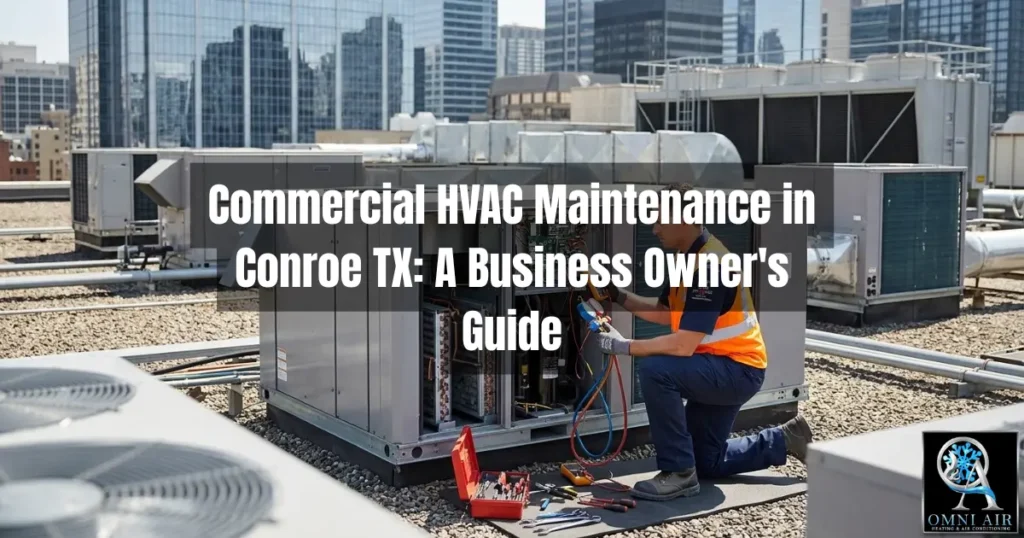
The call usually comes in on a Friday afternoon in July. A restaurant owner in Conroe has a dining room sitting at 79 degrees, a full weekend ahead, and a rooftop unit nobody has opened since it was installed. When I get up on the roof, the condenser coil is matted so thick with kitchen grease and lint that I cannot see the fins. The compressor has been running hot for two summers. It did not break that day. It broke slowly, and nobody was watching.
I am Joseph Miller, a technician with Omni Air & Heating LLC, and I service rooftop units, split systems, and small commercial buildings across Conroe, Willis, The Woodlands, and the rest of Montgomery County. This guide is how I explain commercial HVAC maintenance to business owners: what a real visit covers, how often your building needs one, what changed with refrigerant rules in 2026, and how to tell a solid maintenance contract from a cheap one.
How I know this: I run commercial maintenance and repair calls on restaurants, dental and medical offices, retail strip centers, churches, and offices in the Conroe area. The checklist, mistakes, and case studies below come from those roofs, not from a manufacturer brochure. Omni Air & Heating LLC holds Texas license number TACLA105873C.
Quick answer
Most Conroe businesses need commercial HVAC maintenance at least twice a year, once before cooling season and once before heating season. Restaurants, medical offices, and any building with rooftop units running 12 or more hours a day should be serviced quarterly. A real visit includes electrical testing, refrigerant readings, coil and drain cleaning, belt and filter work, an economizer test, a schedule review, and a written log of readings.
What Commercial HVAC Maintenance Actually Covers
Commercial HVAC maintenance is scheduled inspection, cleaning, testing, and record-keeping on the heating and cooling equipment that serves a business, done before something fails instead of after. That sounds like a home tune-up with a bigger unit. It is not, and treating it that way is where most problems start.
| Item | Typical home | Typical Conroe commercial building |
| Where the equipment sits | Attic air handler, condenser in the yard | Packaged rooftop units, split systems, sometimes mini-splits |
| Power | Single-phase 240V | Often three-phase 208V or 460V |
| Blower drive | Mostly direct-drive | Many units still belt-driven |
| Outside air | Little or none on purpose | Required ventilation, often through an economizer |
| Run hours | Mostly evenings and weekends | Full business hours, 12 to 16 hours a day in kitchens |
| Cost of a breakdown | An uncomfortable night | Lost sales, spoiled product, a closed door |
There is a national standard for this work. ANSI/ASHRAE/ACCA Standard 180 sets minimum inspection and maintenance requirements for commercial building HVAC. The U.S. Department of Energy’s Better Buildings summary says the standard exists to preserve a system’s ability to achieve “acceptable thermal comfort, energy efficiency, and indoor air quality.” I build our commercial task lists so they line up with it, then add what our Gulf Coast humidity demands on top.
How Often Should a Conroe Business Schedule HVAC Maintenance?
Twice a year is the floor. In Montgomery County, cooling equipment often runs from March into November, so a commercial unit here can log far more compressor hours than the same unit in a mild climate. The more hours and the dirtier the air around the unit, the shorter the gap between visits should be.
| Business type | Visits per year | What I focus on |
| Restaurants and food service | 4 (quarterly) | Grease on condenser coils, kitchen make-up air, condensate drains, belts |
| Medical and dental offices | 4 | Humidity, filtration, steady temperatures for patients and equipment |
| Retail and strip centers | 2 to 4 | Multiple rooftop units, economizers, after-hours schedules |
| Offices | 2 to 3 | Thermostat schedules, hot and cold complaints, filter loading |
| Churches and event spaces | 2 | Units that sit idle, then run hard on weekends |
| Warehouses and shops | 2 | Dust loading on coils, unit heaters before winter |
Filters run on their own clock. A busy kitchen or a dusty shop may need filters every month, while an office might go two or three. Our filter change schedule guide covers how loading changes that timeline.
Commercial HVAC Maintenance Conroe TX: What I Check on a Rooftop Unit
Most Conroe strip centers, offices, and restaurants run packaged rooftop units (RTUs). This is the order I work in on every one. The order matters, because each step tells me what to look for in the next.
1. Talk to the people inside first
Before I climb the ladder, I ask the manager or front desk three things: which room is always hot or cold, whether anything smells musty, and whether the unit has been making new noises. Staff notice patterns a single visit will miss. A hostess who says the back booths are warm every day after 2 PM just told me where to look.
2. Electrical, with proper lockout
I shut off the disconnect, lock it, and verify it is dead. Then I tighten lugs, check the contactor for pitting, and meter every capacitor against the rating printed on its side. With power back on, I measure amp draw on the compressor and fan motors and compare it to the nameplate. On three-phase units I check voltage on all three legs, because an imbalance between legs makes motors run hot. Most of the nuisance breaker trips I chase on commercial roofs start right here.
3. Refrigerant readings, written down every time
I take suction and discharge pressures, superheat, and subcooling, and I log them. One set of numbers tells me very little. Four visits of numbers tell me whether a circuit is slowly losing charge. I also look for oily spots on fittings and coil joints, which often mark a leak long before the system runs short. This record matters even more now because of the 2026 EPA rules covered below.
4. Coils, drain pans, and condensate lines
I wash the condenser coil, inspect the evaporator coil, and flush the condensate pan, trap, and line. On a muggy Conroe afternoon a rooftop unit pulls a lot of water out of the air, and all of it has to leave through a small drain. When that drain clogs, the first sign is often water coming through a ceiling tile right under the unit.
5. Belts, bearings, and the blower
Belt-driven blowers need tension and alignment checks every visit. A loose belt squeals at startup and slips under load, which cuts airflow and makes the coil run colder than it should. I check the sheaves for wear and the bearings for play. On high-run units like restaurants, I replace belts once a year whether they look tired or not, because a belt costs far less than a lost Saturday.
6. The economizer and outside air
An economizer is a set of dampers that brings in outside air when it is cool and dry enough to help. When one sticks open in Conroe in August, the building pulls in hot, wet air all afternoon and the unit cannot keep up. When one sticks closed, the space gets no fresh air. I command the damper through its full stroke and check the sensors. In my experience, this is the item cheap maintenance visits skip most often.
7. Controls and schedules
I compare thermostat or control schedules to the real business hours. ENERGY STAR warns that settings changed for a special event often “never get changed back to their original setting,” and its commercial O&M guidance lists periodic schedule reviews as part of preventive maintenance. I find a strip center unit cooling an empty store at 2 AM about once a month. A programmable or smart thermostat with a locked schedule fixes most of that.
8. The heat section on the fall visit
Conroe does not get many cold days, but the ones we get matter. On gas packs I inspect the heat exchanger for cracks, clean the burners, check the flame sensor, and test for carbon monoxide at the supply. On electric heat I check strip amp draw and limit switches.
9. A written report you can actually use
Every visit ends with readings, photos, and a short list of parts that are wearing out, ranked by urgency and priced. You should be able to hand that report to a landlord, an insurer, or a new manager and have it make sense.
Quick diagnostic table for business owners
| What you notice | What it usually means | What we check first |
| One area always runs warm | Dirty coil, low charge, or a damper or duct problem | Coil condition, pressures, supply air temperature |
| Musty smell or sweating supply grilles | High indoor humidity, fan set to ON, or an oversized unit | Fan setting, coil, indoor humidity reading |
| Ceiling stain under the rooftop unit | Clogged condensate drain or roof curb leak | Drain pan, trap, curb seal |
| Breaker trips on hot afternoons | Weak capacitor, failing compressor, loose connection | Amp draw, lug torque, capacitor reading |
| Squeal at startup | Loose or worn belt | Belt tension, sheave wear |
| Bills rising with no change in hours | Schedule drift, economizer fault, dirty coils | Control schedules, damper stroke test |
The 2026 EPA Refrigerant Rules: What Conroe Business Owners Should Know
This is the part almost no local page covers yet. Beginning January 1, 2026, EPA leak repair requirements under the AIM Act apply to appliances holding 15 pounds or more of a refrigerant that contains an HFC or certain HFC substitutes. According to EPA’s January 2026 fact sheet, owners or operators must run a leak rate calculation “each time a refrigerant is added” to a covered appliance.
| Rule detail | What the EPA fact sheet says |
| Who is covered | Appliances with 15 lbs or more of HFC refrigerant (or a substitute with a GWP above 53) |
| Leak rate trigger | 10% for comfort cooling, 20% for commercial refrigeration, 30% for industrial process refrigeration |
| Repair deadline | Leaks above the trigger must be identified and repaired within 30 days |
| Verification | Initial and follow-up verification tests for each repaired leak |
| Records | Kept for three years, paper or electronic |
| Main exemption | Residential and light commercial air conditioning and heat pumps |
The exemption is where business owners get confused. EPA describes the light commercial subsector as equipment for cooling individual rooms, single-family homes, and small commercial buildings, and notes that chillers and certain VRF systems fall under their own subsectors. Industry trade press has pointed out that people still debate where “light commercial” ends. Your walk-in cooler is commercial refrigeration, not comfort cooling, so it falls under the 20% trigger if its circuit holds 15 pounds or more. Many single walk-ins hold less than that. Some do not.
What I tell owners to do: ask your technician to record the refrigerant type and factory charge from every nameplate in your building, so you know which units sit at 15 pounds or more. Each time refrigerant goes into one of those, ask for the leak rate calculation in writing and keep it with your records. This is not legal advice, and EPA’s fact sheet itself says it is informational only, but a simple nameplate list keeps you on the right side of it. If you run older equipment, it also helps to understand the R-410A phase-down before you approve a big refrigerant repair.
Conroe’s Real Problem Is Humidity, Not Just Heat
National maintenance guides are written for heat. Here, the water in the air does as much damage as the temperature. EPA’s guidance for commercial buildings is to keep indoor humidity below 60% relative humidity, ideally 30 to 50%, and the same EPA page lists keeping HVAC drip pans clean and flowing as a mold prevention step. When I put a meter in a struggling Conroe office, I regularly see readings in the mid 60s.
The causes I find most often are simple:
- Fan set to ON. After the compressor stops, the fan blows air across a wet coil and puts that water back into the room.
- An oversized replacement unit. It cools the room fast, shuts off, and never runs long enough to pull moisture out.
- A stuck-open economizer. It feeds the building outdoor air that is already close to saturated.
- A dirty evaporator coil. Less airflow and poor contact mean less water removed per hour.
High humidity leads to musty smells, sweating grilles, and mold growth inside air handlers. Businesses close to the water, like the shops and restaurants that serve the Lake Conroe crowd, fight it harder than most. When maintenance alone cannot bring the numbers down, our indoor air quality services cover dehumidification and filtration upgrades.
Case Studies From Conroe-Area Commercial Jobs
Case 1: A restaurant rooftop unit in Conroe
The kitchen exhaust fan sat about ten feet upwind of the rooftop unit, so grease vapor was landing on the condenser coil every day. A plain water rinse did nothing. We used a degreasing foam with two passes, moved the restaurant to quarterly coil cleaning, and replaced a capacitor that was well below its rating.
| Measure | Before | After |
| Dining room temperature at 1 PM in July | 79°F | 72°F |
| Compressor amp draw vs. nameplate | About 119% | About 95% |
| Condenser coil | Matted with grease and lint | Clean, fins visible |
| Unscheduled calls in the next 90 days | 3 the prior summer | 0 |
Case 2: A dental office with a musty smell
Staff complained of a damp smell in two treatment rooms and water beading on supply grilles. The thermostat fan was set to ON, and the condensate trap was holding standing water. We switched the fan to AUTO, rebuilt the trap, cleaned the coil, and the smell was gone within a week.
| Measure | Before | After |
| Indoor relative humidity (afternoon) | 67% | 52% |
| Thermostat fan setting | ON | AUTO |
| Condensation on supply grilles | Daily | None reported |
| Drain pan | Standing water | Draining clean |
Case 3: A six-unit retail strip center
The owner had been calling only when a tenant complained. We put all six rooftop units on a quarterly plan and logged readings on each one. The first visit turned up failed economizer dampers and three thermostats still cooling empty stores overnight.
| Measure | Year before plan | First year on plan |
| Unscheduled calls, May to September | 10 | 3 |
| Units with stuck economizer dampers | 4 of 6 found | Repaired, tested each visit |
| Units cooling overnight with no tenants | 5 of 6 | 0 |
| Summer electric bill change | Baseline | around 20% |
What I Got Wrong at First
I did not walk into commercial work knowing all of this. A few honest misses that changed how I work:
I treated rooftop units like big home systems. Early on I would clean the coil, change the filter, check charge, and leave. I was skipping belts, economizers, and three-phase voltage, which is where a lot of commercial failures start. A unit I had signed off on lost its blower belt two weeks later on a 98 degree day.
I did not log readings. I would check the charge, call it fine, and move on. Then a unit ran short on refrigerant and I had nothing to show how fast it had been dropping. Now every visit gets written numbers, and that habit happens to line up with what the 2026 EPA rules expect.
I scheduled a restaurant visit at 11 AM. Shutting down a rooftop unit at the start of lunch rush is a good way to lose a customer. Now restaurant visits go first thing in the morning, before prep gets busy.
I trusted the display. A control screen said the economizer was active. The damper had not moved in years. Now I stroke-test every damper by hand instead of believing the screen.
I called a restaurant coil cleaning a rinse. Water alone does nothing to cooked-on grease. It takes a degreaser and two passes, and I price it that way so owners are not surprised.
Common Mistakes I See Conroe Business Owners Make
- Buying on visit price alone. A cheap visit that is really a filter swap and a glance at the thermostat costs more in the long run. Ask for the task list.
- Not reading the HVAC clause in the lease. Many triple-net leases put maintenance and repairs on the tenant. Find out in March, not on the first 100 degree day.
- Skipping the fall visit. Cracked heat exchangers and failed limit switches do not announce themselves until the first cold morning.
- Letting other trades walk on the units. Roofers and sign crews bend coil fins and leave panels loose. Ask them to stay clear, and check the units after any roof work.
- Running the fan on ON for “better circulation.” In our climate it usually raises indoor humidity.
- No refrigerant records. Under the 2026 rules, units with 15 pounds or more need leak rate calculations each time refrigerant is added.
- Waiting until July to plan a replacement. Knowing how long a system realistically lasts here lets you budget a replacement for spring instead of paying rush prices mid-summer.
How to Read a Commercial HVAC Maintenance Contract
A maintenance agreement is only as good as what it promises in writing. Here is what I would look for if I were the one signing.
| What to ask for | Good sign | Red flag |
| Texas license | TDLR license number on the contract and the right class for your equipment size | No license number, or a Class B contractor on a building over 25 tons |
| Task list | A written checklist for each visit type | “Inspect and adjust as needed” and nothing else |
| Readings | Amps, voltages, pressures, and temperatures logged every visit | A checkmark with no numbers |
| Coil cleaning | Included, with the method stated | Billed as an extra every time with no schedule |
| Filters | Sizes, MERV rating, and change frequency listed | “Filters as needed” |
| Refrigerant records | Leak rate calculations for units of 15 lbs or more | No mention of the 2026 rules |
| Repairs | Written estimate before any repair work | Pre-approved repairs up to an open dollar amount |
On licensing, the Texas Department of Licensing and Regulation is clear: a Class A license covers any size unit, while a Class B license is limited to cooling systems of 25 tons and under and heating systems of 1.5 million BTUs per hour and under. A good-sized strip center or church can pass 25 tons of total cooling, so check the class against the work.
Budgeting: Maintenance Versus Breakdowns
The best public data on this comes from the federal government’s own buildings. The DOE Federal Energy Management Program’s Operations and Maintenance Best Practices Guide lists an “estimated 12% to 18% cost savings over reactive” maintenance for preventive programs. The same guide estimates that well-run O&M programs can cut energy bills by roughly 5% to 20% without major capital spending. Those are national figures, not a promise for your building, but they match what I see on roofs here.
I suggest owners split their HVAC budget into three lines: a fixed maintenance line, a small repair reserve, and a replacement fund for units past about 12 years old. When a replacement comes up, compare SEER2 efficiency ratings on the quotes, because the run hours on a commercial unit make efficiency pay back faster than at home. If a failure hits before the fund is ready, our HVAC financing options can spread out the cost, and our AC repair team will tell you honestly whether a repair is worth it on an aging unit.
Why Choose Omni Air & Heating LLC for HVAC Solutions
Omni Air & Heating LLC is a licensed HVAC company based in Montgomery, Texas, and we have been running residential and commercial calls across Montgomery County for years. Here is what that means for a business owner in Conroe:
- Local techs who know our climate. We work in Conroe, Willis, The Woodlands, Magnolia, Montgomery, and the lake communities, and we build maintenance around Gulf Coast humidity, not a national template.
- Readings, not guesses. Every commercial visit gets logged numbers and photos, so you can see a problem coming and plan for it.
- Scheduling that respects your hours. We are open Monday through Friday, 8 AM to 5 PM, and we book restaurants and clinics first thing in the morning so you are running before customers arrive.
- Straight pricing. You get a written estimate before any repair, and we will tell you when a repair makes sense and when it does not.
- Licensed and reviewed. Texas license TACLA105873C, a Nextdoor Neighborhood Favorite for 2026, and a long run of Google reviews from local customers.
If you want a commercial HVAC maintenance plan built around your building, your hours, and your equipment list, we will start with a walk-through and a nameplate inventory of every unit.
Frequently Asked Questions
How often should a business in Conroe, TX service its HVAC system?
At least twice a year: a spring cooling visit and a fall heating visit. Restaurants, medical and dental offices, and buildings whose rooftop units run 12 or more hours a day should be on a quarterly schedule, because Conroe’s long cooling season puts far more run hours on the equipment than the national average.
What does a commercial HVAC maintenance visit include?
A real visit covers electrical testing (voltage, amp draw, capacitors, contactors), refrigerant pressure and temperature readings, condenser and evaporator coil cleaning, condensate pan and drain flushing, belt and bearing checks, filter changes, an economizer damper test, a review of thermostat schedules, and a written report with the readings so they can be compared visit to visit.
Do the 2026 EPA refrigerant leak repair rules apply to my business?
They can. Since January 1, 2026, EPA leak repair rules cover appliances holding 15 pounds or more of an HFC refrigerant with a GWP above 53. Residential and light commercial air conditioning and heat pumps are exempt, but walk-in coolers, chillers, larger split systems, and some VRF systems may be covered. Have your technician list the refrigerant type and charge from each nameplate so you know which units count.
Should the thermostat fan in my business be set to ON or AUTO?
In the Conroe area, AUTO is usually the better choice during occupied cooling hours unless your system was designed for continuous fan operation and has dehumidification controls. With the fan on ON, water left on the cold coil can be blown back into the building after the compressor shuts off, which raises indoor humidity.
How long does a commercial rooftop unit last in Texas?
In my experience, rooftop units in Montgomery County that get steady maintenance often reach about 15 years, and some go longer. Grease from kitchen exhaust, skipped coil cleaning, and years of low refrigerant charge are the most common reasons I see them fail early.
Who pays for HVAC maintenance in a leased commercial space?
It depends on the lease. Many triple-net (NNN) leases make the tenant responsible for HVAC maintenance and repairs on the units serving their space, while other leases leave it with the landlord. Read the HVAC clause before cooling season and keep your maintenance records, since some leases require proof of regular service.
What license should a commercial HVAC contractor have in Texas?
A Texas Air Conditioning and Refrigeration Contractor license from TDLR. A Class A license covers equipment of any size. A Class B license is limited to cooling systems of 25 tons or less and heating systems of 1.5 million BTU per hour or less, so a larger building needs a Class A contractor.
Final Thoughts
Commercial HVAC maintenance in Conroe is not about a sticker on the unit that says someone came by. It is about readings that show what is changing, coils and drains that stay clean through a long humid summer, economizers that actually move, and records that keep you ready for the 2026 refrigerant rules. A business that gets those basics right spends less on emergencies and almost never closes early because the building got too hot.
If your building needs a maintenance plan or a second opinion on the one you have, call us at (281) 767-6664.
Recent Articles:
- How the 2021 Texas Freeze Changed the Way Homeowners Think About HVAC
- Commercial HVAC Maintenance in Conroe TX: A Business Owner’s Guide
- How to Prepare Your HVAC System for a Montgomery TX Winter
- Air Duct Cleaning Montgomery TX: Do You Actually Need It?
- Mold and Your HVAC System: What Montgomery TX Homeowners Need to Know

Joseph Miller is the owner and lead Heating & Air Conditioning Specialist at Omni Air & Heating LLC, proudly serving Montgomery, Texas and surrounding communities since 2020. Joseph brings hands-on experience diagnosing, repairing, and installing residential and light commercial heating and cooling systems. His expertise includes air conditioning systems, heat pumps, furnace repair, system replacements, ductless mini splits, and indoor air quality solutions designed for the unique climate conditions of Southeast Texas.
0 Comments