
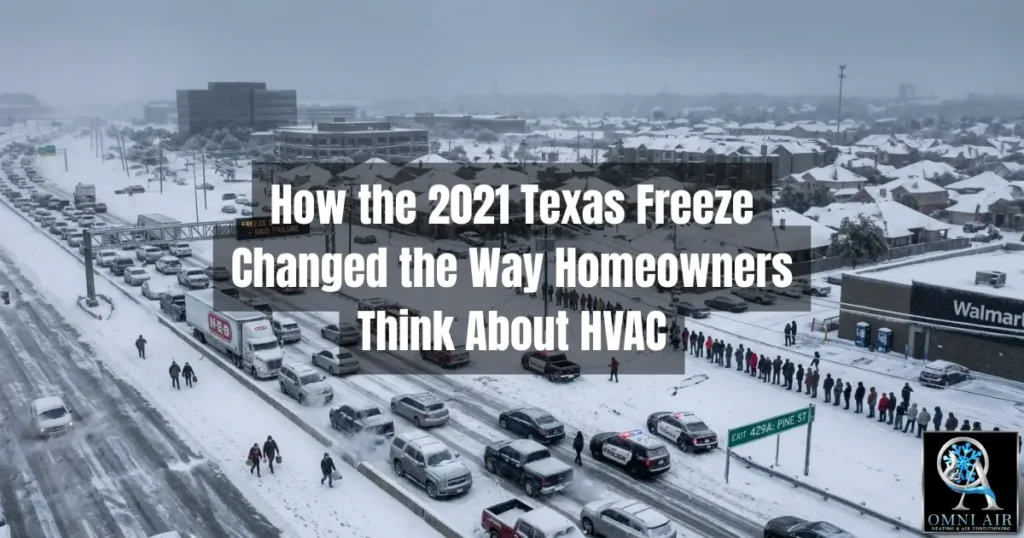
Before February 2021, almost nobody in Montgomery County asked me about heating. They asked how cold the AC would blow in August and how much the new system would save on summer bills. Heat was the thing that came on a few mornings a year.
That changed in one week. When the power came back, I spent the next month in attics and side yards from Montgomery to Magnolia, and the questions homeowners asked me were completely different from anything I had heard before. Can my system run on a generator? Why did my neighbor with gas have heat and I didn’t? Did the cold break my heat pump? Five years later, people still ask those questions on almost every replacement visit.
This article covers the Texas freeze 2021 HVAC lessons I learned on those calls: what actually failed, what turned out to be myth, the mistakes I made, and how they changed the systems we put in now.
How I know this: I am a licensed HVAC technician with Omni Air & Heating LLC (Texas license TACLA105873C). I ran no-heat and post-outage calls across Montgomery, Conroe, Willis, Magnolia, and the Lake Conroe area during and after Winter Storm Uri, and I have done heating replacements and generator-ready setups here ever since. The call data and case study below come from our own service records.
Quick Answer: The Biggest Texas Freeze 2021 HVAC Lessons
- Most Texas homes heat with electricity. When the power went out, the heat went with it, gas furnaces included.
- Electric heat strips are the biggest power draw in most homes. A typical portable generator cannot run them.
- The restart caused damage, not just the cold. Surges and every home restarting at once took out contactors, capacitors, and control boards.
- Ice can block gas furnace vents, and that is a carbon monoxide risk the state tied directly to deaths.
- Refrigerant does not freeze in Texas weather. Most “frozen” systems had a different, fixable problem.
- Homeowners now plan heat around outages, with dual fuel systems, generator-ready wiring, and CO alarms.
What Actually Happened in February 2021, by the Numbers
A lot of what gets repeated about the storm is half right. Here is what the primary sources actually say.
| Fact | Figure | Primary source |
| Lowest temperature at Houston Intercontinental (IAH) | 13°F on Feb. 16, tying an 1895 record | NWS Houston/Galveston, Feb. 2021 Climate Summary |
| Rolling blackouts ordered by ERCOT | 20,000 MW | FERC final report release |
| Time grid frequency stayed below 59.4 Hz | 4 min 23 sec | ERCOT board presentation, Feb. 24, 2021 |
| Share of power plant outages from freezing or fuel issues | 75.6% (44.2% freezing, 31.4% fuel) | FERC final report release |
| Confirmed storm-related deaths in Texas | 246 across 77 counties | Texas DSHS final report |
| Deaths from hypothermia | 158 (64.2%) | Texas DSHS final report |
| Deaths from carbon monoxide | 19 (7.7%) | Texas DSHS final report |
| Montgomery County storm-related deaths | 3 | Texas DSHS final report, Table 1 |
One correction you will see me make in conversations: the grid was not “4 minutes and 37 seconds” from collapse, the number that went around online. ERCOT’s own board presentation says frequency stayed “Below 59.4 Hz for 4m 23s,” and that “More Gen Units would have tripped if below 59.4 for 9m or more.” Either way, it was close.
FERC Chairman Rich Glick called the federal report on the storm “a sobering analysis that highlights the significant work that needs to be done.” Most of that work is on power plants and gas supply. The part homeowners control is what happens inside the house when the grid struggles, and that is where HVAC comes in.
Lesson 1: Texas Heats With Electricity, and That Shaped the Whole Storm
The American Council for an Energy-Efficient Economy (ACEEE) found that “Over 25% of Texas households (2.76 million units in 2020)” use central air conditioning paired with an electric resistance furnace. Its fact sheet adds that “2021’s Winter Storm Uri would have produced an all-time record peak if the power stayed on.” You can read the numbers in the ACEEE Transforming Texas fact sheet.
That matches what I see in Montgomery County attics. A huge number of homes here have an air handler with 10 to 15 kW of electric heat strips, either as the only heat or as backup for a heat pump. In a normal winter the strips run a few hours. During Uri, with the heat pump struggling at temperatures in the teens, the strips ran nonstop in every one of those homes at the same moment. Heat pumps were part of the answer, not the problem. The U.S. Department of Energy says a modern air-source heat pump “can reduce your electricity use for heating by up to 75% compared to electric resistance heating.” The trouble is that older, standard heat pumps lose a lot of capacity in the teens, so the strips take over. If you are weighing a change, here is how a heat pump compares to central AC with strip heat in our climate.
Lesson 2: Your Heat Only Works if It Has Power
The question I heard most in 2021 was some version of: “My neighbor has gas heat. Why did his house stay warm when mine didn’t?” Usually the answer was not the gas. It was that his gas furnace only needed a small amount of electricity to run, and he had a way to supply it.
What Your Heating System Needs From a Generator
| Heating equipment | Rough electrical need | Can a typical portable generator run it? |
| Electric heat strips, 10 kW | About 10,000 watts (about 42 amps at 240 volts) | No. This is more than most portable units can supply alone. |
| Electric heat strips, 15 kW | About 15,000 watts (about 63 amps at 240 volts) | No. Needs a large standby generator. |
| Heat pump compressor (3 ton), no strips | Several thousand watts running, with a large start-up surge | Sometimes, with a soft-start kit and enough generator capacity. Check the nameplate. |
| Gas furnace (blower, inducer, controls) | Usually several hundred watts to about 1,000 watts | Usually yes, with a transfer switch or interlock and clean power. |
The strip figures are simple math: watts divided by volts equals amps. The heat pump and furnace ranges vary by model, so check the nameplate on your equipment or have a tech measure the actual draw.
The Details That Decide Whether a Furnace Runs on a Generator
Here is what I learned the hard way that no generator ad tells you:
- Modern furnace control boards are picky. Many check polarity and grounding before they light. A generator with a floating neutral, or a cheap unit with rough power, can make the furnace refuse to fire even though the blower runs. An inverter generator or a properly bonded setup usually fixes it.
- Variable-speed (ECM) blower motors do not like dirty power either. Same fix.
- Never backfeed through a dryer outlet with a double-ended cord. It can send power out to the lines and injure a lineman, and it bypasses every safety in your panel. Use a transfer switch or a panel interlock with a proper inlet, installed by a licensed electrician.
- Run the generator outside. The CDC says to operate it more than 20 feet from windows, doors, and vents and never in a garage, even with the door open.
If your home has strip heat only, a generator plan usually means either a large standby unit or a change in heating equipment. That is a conversation, not a sales pitch, and it depends on your house.
Lesson 3: The Restart Did as Much Damage as the Cold
This is the lesson I see missing from almost every article about the freeze. When power came back to a neighborhood, every heat pump, every strip heater, and every space heater on the street tried to start at the same instant. Some homes got voltage dips and surges for hours as power was rotated on and off.
After the storm, a lot of what I replaced was electrical: burned contactors, failed run capacitors, fried thermostat transformers, and control boards that never came back. The equipment had not frozen. It had been switched on and off dozens of times under bad voltage. An insurance engineering analysis published after the storm noted that surge was the cause of loss for 11% of HVAC systems it assessed in 2020, before Uri, which tells you how common surge damage is even in normal years.
What I tell customers now is simple:
- When the power goes out, set the thermostat to Off.
- When power returns, wait 5 to 10 minutes so voltage can settle and the compressor’s pressures can equalize.
- Then turn the heat back on, in normal Heat mode.
- Consider a whole-home surge protector and a surge protector at the outdoor unit. Ask your electrician or HVAC tech.
If a breaker trips the moment the system restarts, leave it off and call. It is the same warning sign as an AC tripping the breaker in July.
Lesson 4: Ice and Gas Furnace Vents Do Not Mix
The Texas DSHS report did not just count carbon monoxide deaths. It listed how they happened: “inappropriate use of generators, grills, heaters, vehicles running in enclosed spaces, and ice obstructing vents in gas powered heating equipment.” That last cause is an HVAC issue, and most freeze articles skip it.
High-efficiency gas furnaces vent through two white PVC pipes, one bringing air in and one sending exhaust out. On many Montgomery County homes those pipes come out a side wall, sometimes only a foot or two above the ground or under an eave where ice builds up. When sleet and ice cover them, the furnace either shuts down on a pressure switch or, if something is damaged or installed wrong, exhaust can find its way back toward the house.
Older chimneys and flues had their own problems. On Feb. 15, 2021, the Montgomery County Fire Marshal’s Office had reported 17 structure fires and said, “Many of these have been chimney fires as residents try to keep their homes warm,” according to Community Impact.
Before a freeze, walk outside and find your furnace vent pipes. Keep them clear of ice, snow, and stored items. Install battery-operated or battery back-up CO detectors near every sleeping area, as the CDC recommends. The CDC also notes that more than 400 Americans die each year from unintentional carbon monoxide poisoning not linked to fires.
Lesson 5: Refrigerant Did Not Freeze. Here Is What Really Failed
Right after the storm, I heard “my refrigerant froze” from homeowners and, frankly, from a few contractors. It did not. Refrigerant freezes at temperatures far below anything on Earth. An engineering review of post-storm insurance claims put the freezing point of R-410A at about -247°F. Cold does not crack copper lines or cause refrigerant leaks.
| What homeowners thought | What I actually found | Fix |
| “The refrigerant froze.” | Outdoor coil buried in ice because the defrost control or sensor had failed | Repair defrost board or sensor |
| “The cold killed my heat pump.” | Burned contactor or capacitor from repeated restarts and surges | Replace part, add surge protection |
| “The heat just quit.” | Frozen condensate line tripped the float switch on an attic furnace | Thaw and reroute or insulate the line |
| “The heat smells like it is burning.” | Heat strip element or sequencer overheated after days of nonstop use | Replace strip or sequencer |
| “The unit is ruined.” | Burst water pipe above the air handler soaked the unit and controls | Dry out, test, replace damaged parts |
The bottom line: most systems that “froze” were repairable. A few were not, usually older units where the storm finished off a compressor that was already worn. If you are deciding whether to repair or replace an older system, here is how long an AC unit lasts in Texas and how I make that call.
What We Saw on Post-Storm Service Calls
I went back through our tickets from the three weeks after power was restored, Feb. 18 through March 12, 2021, and sorted them by what we actually found.
| Cause found | Calls | Freeze-related? |
| Contactor, capacitor, or board failure after restart or surge | 21 | Indirect (power restoration) |
| Heat strip, sequencer, or limit failure from nonstop running | 14 | Indirect (heavy use) |
| Iced outdoor unit with failed defrost control | 9 | Yes |
| Frozen condensate line or tripped float switch | 8 | Yes |
| Water damage to air handler from burst pipes | 6 | Yes (plumbing) |
| Tripped breaker or thermostat issue only | 10 | No, setup issue |
| Worn compressor failed during storm | 5 | Storm finished an old part |
| Total | 73 | Only 23 (32%) were direct freeze damage |
Less than a third of those calls were direct freeze damage. Almost half came from the way the power came back and from strips running for days. That is the single biggest reason I talk about restarts and surge protection with every customer now.
How Homeowner Questions Changed After the Freeze
The bigger change was in how people shop for a new system. I compared replacement consultations from the two years before the storm with the most recent two years.
| Homeowner asked about… | 2019 to 2020 | 2024 to 2025 |
| Running heat on a generator | Under 5% | About 40% |
| Dual fuel (heat pump plus gas furnace) | About 5% | About 25% |
| How the heat pump performs in the teens | Rarely | About 35% |
| CO alarms and furnace venting | Rarely | About 20% |
| Surge protection | Rarely | About 30% |
People also started asking smarter thermostat questions, like how to keep heat strips from running every morning.
Case Study: A Montgomery Home That Switched to Dual Fuel
One family near Montgomery lost power for about three days in 2021. Their 2006 heat pump had 15 kW of heat strips as backup and no gas furnace, so a generator could not keep the heat on. The house already had gas service for the water heater and range. After the storm, the dad bought a portable generator, then found out it could run the fridge and lights but not the heat.
In 2023 we replaced the system with a dual fuel setup: a new heat pump paired with a gas furnace, plus a generator inlet and interlock installed by their electrician. The heat pump handles most of the winter. The furnace takes over in hard cold and can run on their generator. We set the switch-over temperature for their home and set the thermostat to keep strips out of the picture.
| Measure | Before (2006 heat pump + 15 kW strips) | After (dual fuel) | Change |
| Heat during a power outage | None | Yes, furnace on 7,500 W portable generator | Heat stays on |
| Peak heating electrical draw | About 18,000 W with strips on | About 900 W in furnace mode | About 95% lower |
| December to February electric use | 5,900 kWh | 3,700 kWh | -37% (gas use added) |
| January 2024 cold snap | N/A (new system) | Furnace ran, no comfort calls | Worked as planned |
Two honest caveats. The electric savings are partly offset by a new gas bill, so the real win here is resilience, not just cost. And dual fuel only makes sense if gas is available at the house. For homes without gas, a cold-climate heat pump with a well-planned generator setup is the option I look at. We install both through our furnace installation service.
What I Got Wrong in 2021
I told people to switch to Emergency Heat when the power came back. I thought it would get the house warm faster while the heat pump struggled. All it did was put every strip in the neighborhood on at once, the worst thing for a weak grid and the most expensive way to heat. Now I tell people to leave a heat pump in normal Heat and let the system bring on backup heat only when it needs it.
I blamed the cold for failures that were really surge damage. On my first few calls, I saw a dead outdoor unit and assumed the freeze. When I started checking contactors, capacitors, and boards first, I found most of those units were electrical failures from the restart. That changed how I diagnose, and how I write it up for customers filing insurance claims.
I did not ask about generators before the storm. I had installed systems for years without once asking if the family wanted heat during an outage. Now it is a standard question on every replacement, because the answer changes which equipment makes sense.
Common Mistakes Homeowners Still Make Five Years Later
| Mistake | Why it hurts | Do this instead |
| Buying a generator without checking the heating load | It may not run strip heat at all. | Have the heating draw measured first. |
| Backfeeding through a dryer outlet | Shock and fire risk, endangers line crews. | Transfer switch or interlock by a licensed electrician. |
| Leaving the thermostat on when power returns | Every system restarts at once on bad voltage. | Set to Off, wait, then turn heat back on. |
| Using Emergency Heat in every cold snap | Runs strips only, highest cost and grid load. | Leave a heat pump in Heat. |
| Ignoring furnace vent pipes in a freeze | Ice can shut down the furnace or create a CO risk. | Keep vents clear and run CO alarms. |
| Assuming the freeze ruined the system | Leads to replacing a system that needed a $200 part. | Get a real diagnosis first. |
Leaky attic ducts also make hard cold worse, because heat escapes before it reaches the rooms. If some rooms never warm up, check the signs your ductwork needs repair.
Your Post-2021 Freeze Plan for HVAC
If you only do a few things before the next hard freeze, do these:
- Know your heating type and its electrical draw. Write the strip size down.
- Decide now whether you want heat during an outage, and plan the equipment and wiring to match.
- Get a fall heating tune-up so defrost controls, strips, burners, and venting are checked.
- Find your furnace vent pipes and keep them clear. Test your CO alarms.
- Learn the restart routine: Off during the outage, wait after power returns, then Heat.
- Add surge protection for the panel and the outdoor unit.
For the full fall routine, see our guide on how to prepare your HVAC system for a Texas winter and the spring and fall tune-up checklist. You can book a check through our HVAC maintenance page.
Why Choose Omni Air & Heating LLC for HVAC Solutions
Omni Air & Heating LLC is a licensed, local HVAC company at 2 Laguna Rd in Montgomery, Texas (TACLA105873C), serving Montgomery County for more than 15 years. We worked through the 2021 freeze with our neighbors, and it shaped how we do the job:
- We ask about outages before we quote. Your plan for heat during a power loss decides whether a heat pump, dual fuel, or a furnace makes sense.
- We diagnose before we replace. We check electrical parts, defrost controls, and strips first, and we document what we find.
- We set systems up for our weather. Switch-over temperatures, aux heat settings, condensate routing, and vent locations that hold up in a hard freeze.
- Straight scheduling. We work Monday through Friday, 8 to 5, and we tell you honestly when we can be there. Booking before winter keeps you ahead of the rush.
- Local coverage across Montgomery, Conroe, Willis, The Woodlands, Magnolia, Shenandoah, Spring, Bentwater, Pinehurst, Dobbin, Plantersville, and Richards.
If a new system makes more sense than another repair, ask about our HVAC financing options. Call (281) 767-6664 to talk through your home.
Frequently Asked Questions
What did the 2021 Texas freeze teach homeowners about HVAC?
It showed that most Texas heating depends on electricity, so heat fails when the power fails. It also showed that electric heat strips are too large for most portable generators, that restarts and surges damage equipment, and that ice can block gas furnace vents. Many homeowners now plan heating around outages.
Can a portable generator run my heat pump or heat strips?
Usually not for heat strips. A 10 kW strip heater needs about 10,000 watts, more than most portable generators supply. A heat pump compressor alone may run on a large enough generator with a soft-start kit. A gas furnace typically needs under about 1,000 watts and is the easiest to run on a generator with a transfer switch or interlock.
Does refrigerant freeze in a Texas winter?
No. R-410A freezes at about -247°F, far colder than any Texas weather. When a heat pump stops working in a freeze, the usual causes are a failed defrost control, an iced coil, a frozen condensate line, or electrical damage from restarts and surges.
What should I do with my thermostat when the power goes out?
Set it to Off during the outage. When power returns, wait 5 to 10 minutes, then turn the heat back on in normal Heat mode. This avoids restarting on unstable voltage and keeps every home on the street from starting heat at the same moment.
Is dual fuel a good choice for homes in Montgomery County TX?
It can be if your home has natural gas or propane. A dual fuel system uses an efficient heat pump most of the winter and a gas furnace in hard cold, and the furnace can run on a modest generator during an outage. Homes without gas usually look at a cold-climate heat pump and a generator plan instead.
How many people died in the 2021 Texas winter storm?
The Texas Department of State Health Services confirmed 246 storm-related deaths across 77 counties. Hypothermia caused 158 of them, and 19 were from carbon monoxide poisoning, including cases linked to ice blocking gas heating vents.
Should I use Emergency Heat during a hard freeze?
Only if the heat pump itself has failed. Emergency Heat runs only the electric strips, which costs the most and adds the most load to the grid. In normal Heat mode, the system brings on backup heat automatically when it is needed.
Final Thoughts
The 2021 freeze did not change Texas weather. It changed what homeowners ask for. People stopped treating heat as an afterthought and started asking how their system behaves when the grid is under strain: how much power it draws, whether it can run on a generator, how it restarts, and whether the vents can ice over.
Those are the right questions. If you want help answering them for your home before the next hard freeze, Omni Air & Heating LLC is at (281) 767-6664.
- How the 2021 Texas Freeze Changed the Way Homeowners Think About HVAC
- Commercial HVAC Maintenance in Conroe TX: A Business Owner’s Guide
- How to Prepare Your HVAC System for a Montgomery TX Winter
- Air Duct Cleaning Montgomery TX: Do You Actually Need It?
- Mold and Your HVAC System: What Montgomery TX Homeowners Need to Know

Joseph Miller is the owner and lead Heating & Air Conditioning Specialist at Omni Air & Heating LLC, proudly serving Montgomery, Texas and surrounding communities since 2020. Joseph brings hands-on experience diagnosing, repairing, and installing residential and light commercial heating and cooling systems. His expertise includes air conditioning systems, heat pumps, furnace repair, system replacements, ductless mini splits, and indoor air quality solutions designed for the unique climate conditions of Southeast Texas.
0 Comments