
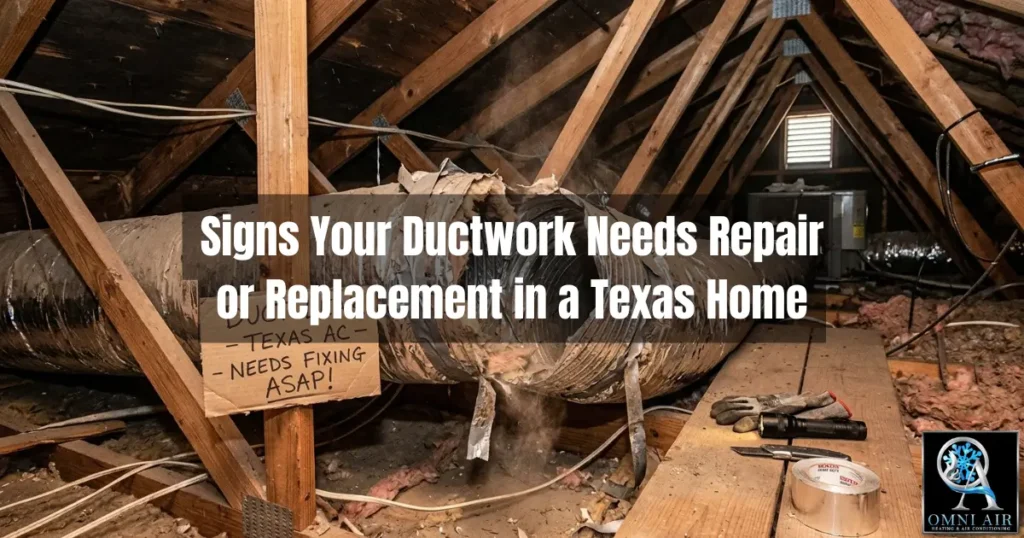
I spend a good part of every summer on my stomach in attics that read north of 130 degrees. That is where most comfort complaints in Montgomery County actually live, and it is the part of the system nobody looks at.
Homeowners call me about equipment. The upstairs will not cool, the bill jumped, the house feels damp. Often the equipment is fine and the ducts are throwing the air away before it reaches a bedroom. ENERGY STAR puts the loss in a typical house at 20 to 30 percent of everything moving through the duct system, blamed on leaks, holes and poorly connected ducts (ENERGY STAR duct sealing flyer, PDF). On the return side, that same gap pulls 130-degree humid attic air back in.
Below are the ductwork repair signs I see on real calls, what I measure to confirm each one, and the line I draw between sealing a system and replacing it. That last part is what almost every article on this topic skips.
How I know this: I am Joseph Miller, owner and licensed technician at Omni Air & Heating LLC in Montgomery, Texas, license TACLA105873C. My crew and I work duct systems every week across Montgomery, Conroe, Willis, Magnolia, The Woodlands and the Lake Conroe communities. The readings, the case study and the mistakes below come from our own service tickets and attic inspections, not from a manufacturer brochure. Where I cite outside research, I link to the original source, not to somebody else’s article about it.
8 Ductwork Repair Signs I See Most in Montgomery County Homes
1. One room never keeps up, and it is usually the farthest one
The back bedroom runs five to eight degrees warm all afternoon. Before I blame equipment I follow that branch. Nine times out of ten it is kinked over a truss, crushed under blown insulation, or pulled off the boot entirely.
2. Your bill climbed but nothing about how you live changed
The system runs longer to replace what it lost. ENERGY STAR puts leaky ducts at up to 20 percent of system efficiency. I have watched a 17 SEER2 system on tight ducts beat a 20 SEER2 on leaky ones. More in my AC brand ranking for Texas homes.
3. The house feels sticky at a setting that should be comfortable
The most Texas sign here, and the one most often misread as a refrigerant problem. Return leaks in a hot attic pull moisture-loaded air into the airstream, so the thermostat reads 73 and the house still feels sticky. My indoor air quality guide for Montgomery County covers the symptom; ducts are usually the cause.
4. Dust comes back within days of cleaning
A filter only cleans what passes through it. Air pulled in through a split return plenum or an unsealed filter slot never touches it. If you change AC filters on schedule and furniture still hazes over in three days, the air is bypassing the filter.
5. A whistle, a roar, or a rumble when the blower starts
Ducts should be close to silent. A whistle is air squeezing through a gap or an undersized return. A roar at the return grille means a starved system. A rumble in sheet metal means the trunk is flexing under pressure it was never sized for. All three point at static pressure.
6. Sweating ducts, damp insulation, or a stain on the ceiling
A cold duct condenses the moment its jacket drops below the attic dew point. DOE is explicit that cooling ducts need an intact vapor barrier outside the insulation. Wet fiberglass loses R-value, gets colder, sweats harder, and that loop ends with a brown ring on a ceiling.
7. Interior doors swing, thump, or whistle when the system runs
One of the fastest tells I have. A bedroom with a supply but no return path pressurizes when the door closes, pushing conditioned air out through top plates and can lights. DOE publishes the check I run: close the house up, run the air handler, crack each door. A door that moves on its own has a return problem.
8. The supply vents smell like the attic
Hot insulation, dust, cedar, a sourness after a wet week. A duct system is a closed loop. If you can smell the attic through a register, the loop is open, and whatever is up there is in your air.
What Every Other “Bad Ductwork” Article Leaves Out
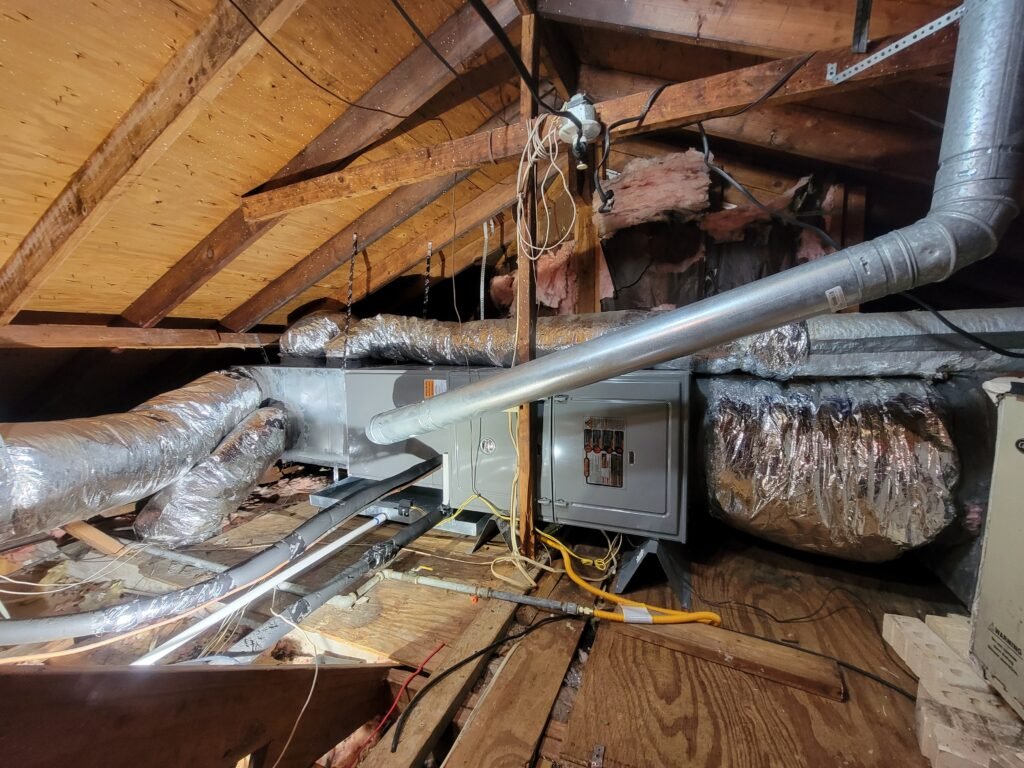
I read the pages currently ranking for this topic before writing mine. They list the same symptoms, then tell you to call a professional. Not one says what to measure, what the reading should be, or where the repair-versus-replace line sits. That is the whole decision.
| What you notice | What I measure | Reading I want | What a failing number tells me |
| One hot room | Anemometer or flow hood at the register, against the room’s design airflow | Within about 10% of design airflow | A crushed, kinked, disconnected or undersized branch run |
| High bills, long run times | Duct leakage test, calibrated fan and manometer at 25 Pa | At or below 4 CFM25 per 100 sq ft of conditioned floor area, the Texas code limit for new work | Every point above that is air you paid to cool going into the attic |
| Sticky house at a normal setpoint | Pressure pan on each register, plus indoor relative humidity | Under 1.0 Pa on the pan; 45–55% RH in cooling season | Return-side leakage pulling humid attic air into the airstream |
| Dust returning fast | Smoke pencil at the return plenum, filter slot and platform return | No visible draw at any seam | Unfiltered attic air bypassing the filter entirely |
| Noise at startup | Total external static pressure across the air handler | At or under the equipment rating, usually 0.5 in. w.c. | Restricted or undersized duct, which shortens blower and compressor life |
| Doors swinging or whistling | Room-to-hall pressure, blower running and door shut | Under 3 Pa | No adequate return path; the room is pushing your air into the attic |
| Sweating ducts | Infrared thermometer on the duct jacket, plus attic dew point | Jacket temperature above the attic dew point | Compressed, wet, torn or under-code insulation |
That threshold is not my opinion. DOE’s Building America program documents the same 4 CFM25 per 100 square feet protocol used for code compliance and ENERGY STAR certification.
Repair or Replace? The Line I Actually Draw
I repair when all of this is true
- Leakage is at a countable number of points: plenum seams, boots, one loose branch.
- The insulation jacket is dry, intact and R-8 or better.
- The flex inner liner is unbroken and the wire helix holds its shape.
- Static pressure returns to range once restrictions are cleared, meaning the ducts are sized right.
- The layout still matches the house, with no addition it was never designed for.
I replace when any one of these shows up
- Leakage still fails after sealing. If I cannot get an existing system under roughly 6 CFM25 per 100 sq ft, the rest of the leaks are unreachable.
- The flex liner is torn or the helix has collapsed. Air is traveling through insulation, not duct, and mastic will not fix that.
- Static pressure stays above rating with a clean filter and sealed leaks. You cannot seal your way out of undersized duct.
- Confirmed mold on porous liner. Fiberglass cannot be cleaned back to clean, and the EPA is blunt: “Duct cleaning has never been shown to actually prevent health problems.”
- Rodent damage or nesting in more than an isolated run.
- Building cavity returns: panned joists, framed chases, a return pulling through a wall cavity. Those are not ducts and they leak by design.
My cost rule, mine rather than an industry standard: if repair runs past roughly a third of full replacement on a system over 15 years old, replacing is the better spend. Same logic I apply to equipment in AC repair versus replacement.
The “ducts last 10 to 15 years” claim is doing damage
That number sells replacements nobody needs. I have opened 1990s sheet metal trunks here that needed nothing but boots and seams sealed, and condemned nine-year-old flex that was hung slack and never supported. Installation quality predicts duct life better than age. Ask for a condition report with readings, not a birth date.
Why Ducts Fail Faster in a Texas Attic
The attic is an oven for months at a time
My infrared thermometer regularly reads 120 to 150 degrees on Montgomery attic decking in July. That heat turns cloth-backed duct tape into a dried ribbon, and a nicked duct jacket that would be a minor efficiency loss in a dry climate becomes a condensation site by June. I use UL 181 mastic on every joint. DOE says it plainly: duct mastic is the preferred material for sealing ductwork seams and joints.
A lot of Montgomery ductwork predates the standard it should meet
Texas’s statewide energy code for single-family homes is the energy chapter of the 2015 International Residential Code, adopted by the State Energy Conservation Office effective September 1, 2016 (SECO, Single-Family Construction). Ducts in an unconditioned attic in our climate zone are supposed to be insulated to R-8, with leakage on new work capped at 4 CFM25 per 100 square feet. Plenty of houses here predate that, and I still pull R-6 and R-4.2 flex out of attics. That becomes a real problem when the equipment gets replaced and nobody upgrades the ducts to match.
A Real Job: A Two-Story in [Willis] Where the Upstairs Never Got Below 79
2,550 square feet, built 2005, a 4-ton system only 7 years old that tested fine on refrigerant and amp draw. The previous company quoted a bigger unit. The equipment was not the problem.
What I found: the return plenum open at two corners, three boots never sealed to the drywall, one 7-inch branch fully disconnected over the garage, and about 35 feet of torn R-6 flex.
What we did: rebuilt and sealed the return plenum, mastic on every boot and seam, reconnected and supported the loose branch, swapped the damaged R-6 for R-8, added a second return upstairs, then retested instead of assuming.
| Measurement | Before | After |
| Total duct leakage | 312 CFM25 / 11.9 per 100 sq. ft | 95 CFM25 / 3.5 per 100 sq. ft] |
| Total external static pressure | 0.95 in. w.c. | 0.57 in. w.c. |
| Upstairs master, 4:00 p.m. | 80°F | 72°F |
| Upstairs relative humidity | 62% | 48% |
| Delivered airflow, back bedroom | 59 CFM | 131 CFM |
| July electric usage | 800 kWh | 450 kWh |
The humidity drop is the number I care about, because comfort at a higher setpoint is what lowers a bill.
What I Got Wrong at First
I sealed with tape.
Foil tape on attic joints was fast and looked finished. I went back to one of those houses about [three] years later and peeled tape off a plenum seam with two fingers. Heat had cooked the adhesive to dust. Everything I seal now is UL 181 mastic.
I sold duct cleaning when the customer needed duct sealing.
A homeowner asked for cleaning because of dust, I cleaned, and it was back inside a month. The real problem was a return plenum drawing attic air past the filter. Cleaning a leaking system just gives it clean surfaces to dirty again.
I replaced supply ducts and ignored the return.
New R-8 supply runs, same undersized return grille. Static pressure barely moved, the far bedroom was still short, and I went back on my own dime. The return is half the system and the half Texas tract construction shortchanges. For real room-by-room control, the answer is often a zoning system.
Three Checks You Can Run Yourself This Weekend
- Run the DOE door test. Close the house up, set the fan to on, then crack each interior door. One that pulls shut or pushes open by itself is a room with restricted return air.
- Compare register temperatures. Hold a probe thermometer in the nearest supply register, then the farthest. Several degrees warmer at the far one means that air is picking up attic heat on the way.
- Read the grille faces. Gray fanning streaks off the edges mean air is moving around the boot instead of through it. That is an unsealed boot, one of the most common things I seal.
The hard stop. Do not walk attic joists in a Texas summer, do not cut into a duct, and do not spray aerosol sealant into a running system. Regular HVAC maintenance catches most of this earlier.
When It Is Time to Call Someone
Call when a room has never been comfortable, when the bill climbed for no reason, when the house feels damp at a normal setting, when there is a ceiling stain under a duct run, or when you find evidence of animals. A real assessment includes a leakage test with a number on it, a static pressure reading, room-by-room airflow, and a written repair-or-replace recommendation. Quote ductwork without measuring anything and you are selling a guess.
Why Choose Omni Air & Heating LLC for HVAC Solutions
Omni Air & Heating LLC is a local, licensed HVAC company in Montgomery, Texas. Ductwork is not an add-on we upsell at the end of a call. It is the first thing I look at when the complaint is comfort.
- We measure before we quote: leakage, static pressure, room airflow. You get the numbers, then get them again after the work.
- We repair when repair is the right call. Sealing an intact system costs a fraction of replacing it. Our ductwork services page covers all three.
- We match ducts to equipment. If you are looking at AC installation, the ducts get inspected as part of the job, because new equipment on leaky ducts never performs to the label.
- Straight pricing, with financing available when full replacement is the honest recommendation. Serving Montgomery, Conroe, Willis, The Woodlands, Magnolia, Bentwater and the Lake Conroe area, Monday through Friday, 8 to 5.
Frequently Asked Questions
What are the most common signs ductwork needs repair?
One room that never keeps up, a bill that climbed without a change in habits, a house that feels humid at a normal setting, dust returning within days of cleaning, whistling or roaring at startup, sweating ducts or ceiling stains, doors that move on their own, and attic smells at the vents.
How do I know if my air ducts are leaking?
A leakage test is the reliable answer: the system is pressurized to 25 Pa and the loss measured. Total leakage should be at or below 4 CFM25 per 100 square feet of conditioned floor area. Without a test, the strongest clues are unfiltered dust, high humidity, and rooms that never reach temperature.
Should I repair or replace my ductwork?
Repair when leaks are at a countable number of points, insulation is dry and at least R-8, the liner is intact, and static pressure returns to range after sealing. Replace when leakage still fails after sealing, the liner is torn or collapsed, static pressure stays high with a clean filter, there is mold on porous liner, or the returns are building cavities.
Does duct cleaning fix leaky ducts?
No. Cleaning removes debris from inside surfaces and does nothing about leaks, insulation or airflow. The EPA does not recommend routine duct cleaning and notes it has not been shown to prevent health problems. Cleaning is worth doing for visible mold or after a rodent infestation. Sealing fixes leakage.
Can leaky ductwork make my house humid?
Yes, and in Southeast Texas it is a leading cause. Return-side leaks pull hot, moist attic air into the airstream, so the system spends its capacity on attic moisture instead of your house. The result is a home reading 73 degrees that still sits above 60 percent humidity.
Should I replace ductwork when I replace my AC?
Not automatically. Replace it if the ducts are undersized for the new equipment, insulated below R-8, or failing a leakage test after sealing. Keep them if they test tight and are in sound condition. An installer should show you readings rather than bundling replacement in by default.
How much does duct repair cost in Montgomery, TX?
It depends how much of the system is involved. Sealing an accessible plenum and boots is the low end, replacing individual runs the middle, full replacement with redesigned returns the high end. The leakage and static pressure tests come first, because they determine which one you need. Call Omni Air & Heating LLC at (281) 767-6664 for current pricing.
Final Thoughts
In a county where attics run past 130 degrees for months, a duct system leaking 20 or 30 percent is not a rounding error. It is why a room will not cool, why the house feels damp, and why good equipment gets blamed for a distribution problem. Most of it is measurable, and much of it is repairable. Keeping up with regular service keeps small duct problems from becoming comfort complaints.
If you are seeing two or more of the signs above, get a leakage test with a number attached before anybody quotes you anything. Omni Air & Heating LLC is at (281) 767-6664.
- How to Prepare Your HVAC System for a Montgomery TX Winter
- Air Duct Cleaning Montgomery TX: Do You Actually Need It?
- Mold and Your HVAC System: What Montgomery TX Homeowners Need to Know
- HVAC Tips for New Homeowners in The Woodlands TX: A Tech’s First-Year Plan
- AC Allergens: How to Reduce Pollen and Dust in Your Texas Home

Joseph Miller is the owner and lead Heating & Air Conditioning Specialist at Omni Air & Heating LLC, proudly serving Montgomery, Texas and surrounding communities since 2020. Joseph brings hands-on experience diagnosing, repairing, and installing residential and light commercial heating and cooling systems. His expertise includes air conditioning systems, heat pumps, furnace repair, system replacements, ductless mini splits, and indoor air quality solutions designed for the unique climate conditions of Southeast Texas.
0 Comments