
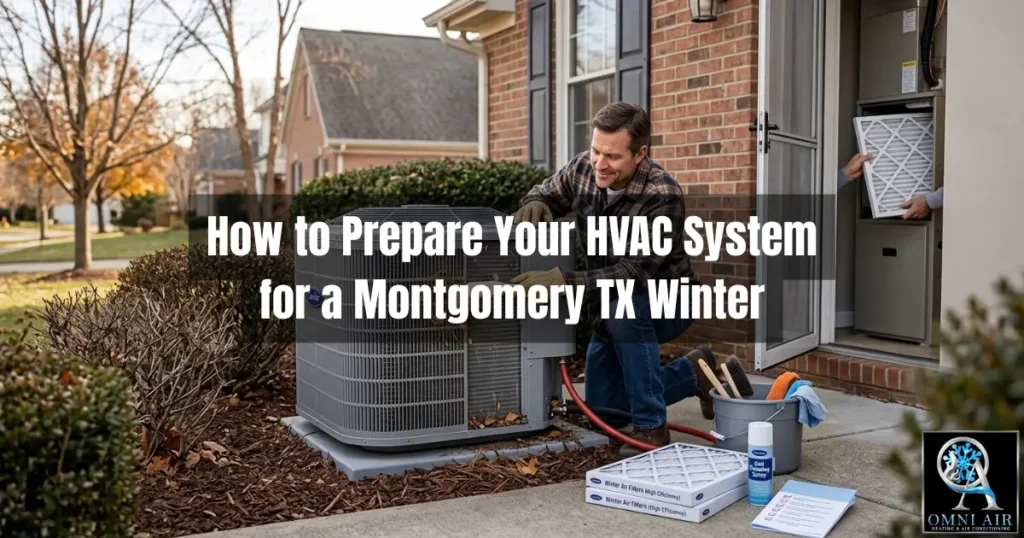
Every year it happens the same way. We run the AC through October, a cold front blows through on a Thursday night, and Friday morning my phone fills up. The heat smells like it is burning. The heat pump is blowing cold air. The furnace clicks but never lights. Most of those calls could have been handled in ten minutes on a mild afternoon two weeks earlier.
This guide is how I prepare HVAC for winter in Montgomery TX homes, in the order I actually do it. It covers the heat pumps with backup heat strips that most newer homes here have, and the gas furnaces sitting in our attics. I will show you what we found on last fall’s first cold-snap calls, one before-and-after job, and the mistakes I made early on so you do not repeat them.
How I know this: I am a licensed HVAC technician with Omni Air & Heating LLC (Texas license TACLA105873C). Every fall I run heating start-ups and no-heat calls across Montgomery, Conroe, Willis, Magnolia, The Woodlands, and the Lake Conroe communities. The steps, numbers, and mistakes below come from those calls, not from a manufacturer brochure.
Quick Answer: How to Prepare Your HVAC for a Montgomery TX Winter
Do these before the first night in the 30s, which in Montgomery County usually lands in mid to late November:
- Make sure the heat strip or furnace breaker is on.
- Put in a clean air filter.
- Run the heat once on a mild afternoon to burn off summer dust.
- Test the thermostat in Heat mode and replace its batteries.
- Clear leaves and pine straw from the outdoor heat pump. Do not cover it.
- Test or install carbon monoxide alarms if you have any gas appliance.
- Check the insulation on outdoor refrigerant and condensate lines.
- Book a professional heating tune-up before the first cold front.
Why Winter Prep Looks Different in Montgomery County
Most winter HVAC guides are written for places where the heat runs from October to April. Ours does not work that way. Our winters are mostly mild, with a handful of hard cold snaps. Conroe’s average first freeze falls in the last week of November. That pattern creates three problems I rarely see written about.
We switch between cooling and heating in the same week. I have run AC calls and no-heat calls on the same day in December. Thermostats left in Cool, or set to Auto with a tight gap, cause a lot of confusion.
The heating side sits unused for eight months. Dust settles on heat strips and burners. Mud daubers and mice move into furnace cabinets in the attic. Breakers get flipped off during summer work and never flipped back.
The rare hard freeze hits a system that was never built for it. Attic condensate lines, outdoor pipe insulation, and the grid itself all get tested at once. The February 2021 storm proved how badly that can go. The Texas Department of State Health Services confirmed 246 storm-related deaths across 77 counties, and its final report counted 19 of them, or 7.7%, as fatal carbon monoxide poisonings. A lot of winter prep here is really about that one bad week.
First, Know Which Heating System You Have
You cannot prep a system if you do not know what it is. Here is how I explain it on the driveway:
| System | How to tell | Main winter risk I see |
| Heat pump with heat strips | Outdoor unit runs in winter. Thermostat shows “Aux” or “Em Heat.” Common in newer Montgomery County builds. | Strips doing all the work. High bills, cold air during defrost, tripped strip breaker. |
| Gas furnace + AC | Furnace in the attic or closet with a metal or PVC flue. Gas line and shutoff valve at the unit. | Dirty flame sensor, rodent damage, cracked heat exchanger, carbon monoxide. |
| Electric furnace / air handler with strips + AC | No gas line. Outdoor unit stays off in heating mode. | Burned strip elements, tripped breaker, very high bills. |
| Dual fuel (heat pump + gas furnace) | Heat pump outdoors, gas furnace indoors. Switches based on outdoor temperature. | Wrong switch-over temperature setting wasting money. |
If you are not sure which one you have, our complete guide to HVAC systems in Montgomery TX walks through each type. If you are weighing a change, here is how a heat pump compares to central AC with a furnace in our climate.
My 8-Step Process to Prepare HVAC for Winter in Montgomery TX
This is the order I follow on a fall heating start-up. Steps 1 through 7 are safe for most homeowners. Step 8 is ours.
1. Check the Heat Breaker Before You Need It
This is the cheapest no-heat call there is, and I run a lot of them. On most heat pump and electric systems, the heat strips have their own breaker, often a double-pole 40 to 60 amp breaker separate from the outdoor unit. It gets switched off during summer repairs, or it trips the first time the strips try to run.
Open your panel and look for a breaker labeled “heat,” “air handler,” or “strips.” Make sure it is fully on. If it trips again as soon as the heat runs, leave it off and call. A breaker that keeps tripping is protecting you from something, the same way it does when an AC keeps tripping the breaker in summer.
2. Put In a Clean Filter, Then Do a Burn-Off on a Mild Day
Start with a fresh filter. A clogged filter cuts airflow, and low airflow makes heat strips and furnaces overheat and shut off on their safety limit. ENERGY STAR tells homeowners to inspect, clean, or change air filters once a month for furnaces and heat pumps. If you need a refresher on size and type, here is how to change your AC filter.
Next, pick a mild afternoon in the 60s, open a couple of windows, and set the thermostat to Heat about 5 degrees above room temperature. Let it run 15 to 20 minutes. The dust that settled on the strips or burners all summer will burn off. That smell is normal the first time. Doing it now means it does not hit you at 6 a.m. on the first cold morning, or set off your smoke alarms. Know the difference: a dusty, slightly burnt smell that fades within an hour is burn-off. A sharp electrical or plastic smell, visible smoke, or a smell that keeps coming back is not. Shut the system off at the thermostat and call.
3. Test the Thermostat in Heat Mode, Not Auto
Replace the thermostat batteries if it uses them. Then switch it to Heat, not Auto, and confirm warm air at a supply vent within a few minutes. Auto mode can mask problems, because the system may pick cooling if your set points are close together. Here is the edge case that catches people. If you replaced your thermostat during the summer, it may be wired or set up wrong for heat pump heating. Heat pumps use a reversing valve, and the thermostat has to be told which way that valve works (often shown as an “O/B” setting). Set wrong, the system cools perfectly all summer, then blows cold air the first time you ask for heat. I fix this a few times every fall. If you own a smart thermostat, also look for an auxiliary heat lockout or “aux heat max outdoor temperature” setting.
4. Clear the Outdoor Heat Pump (and Leave It Uncovered)
A heat pump’s outdoor unit does the heating, so it needs the same airflow in January that it needs in July. Our pine trees drop needles right into the top grille. With the power off at the outdoor disconnect, clear leaves and pine straw from the top and sides, and keep shrubs trimmed back. The U.S. Department of Energy notes that a heat pump moves heat rather than making it, which is why it is so efficient, but it can only move heat if air flows across the coil.
Do not cover a heat pump for winter. Covers are for AC-only condensers up north. Covering a heat pump blocks the coil and can damage it. Even on an AC-only system here, I tell people to skip the tight cover, because it traps moisture and gives rodents a warm home.
5. Take a Flashlight Look at the Attic Furnace
If your furnace is in the attic, which is common across Montgomery County, take a quick look before the season. You are not repairing anything. You are looking for:
- Droppings, nesting, or chewed wires near the furnace cabinet.
- A flue pipe that is loose, disconnected, or rusted through at the joints.
- Water in the secondary drain pan or a float switch that has tripped.
- Anything stored against the furnace. Keep combustibles well clear.
On high-efficiency furnaces (usually about 90% or higher, with white PVC vent pipes), the furnace makes water while it heats. That water runs out through a condensate line that often crosses an unconditioned attic. In a hard freeze, that line can freeze, the water backs up, and a safety switch shuts the furnace down right when you need it most. If your line runs through the attic or outside wall with no insulation or heat tape, mention it at your tune-up.
6. Test or Install Carbon Monoxide Alarms
If you have a gas furnace, gas water heater, gas range, fireplace, or an attached garage, you need working CO alarms. The CDC puts it plainly: carbon monoxide “kills without warning.” It reports that more than 400 Americans die each year from unintentional CO poisoning not linked to fires. The CDC recommends battery-operated or battery back-up CO detectors near every sleeping area, checking batteries when the clocks change, and replacing detectors per the maker’s instructions or every 5 years.
A CO alarm is a backup, not a fix. The real protection is an annual inspection of the burner, flue, and heat exchanger, which is step 8.
7. Check Outdoor Line Insulation and Exposed Pipes
Walk around the outdoor unit. The larger copper refrigerant line should be wrapped in black foam insulation. On a heat pump, that line carries hot refrigerant into the house in winter, so missing or sun-rotted insulation costs you heat. Texas sun eats this foam in a few years. Note any bare sections. Also check that outdoor condensate drains and any hose bibs near the unit are protected before a freeze.
8. Book the Heating Tune-Up Before the First Front
ENERGY STAR advises getting the heating system checked in the fall because contractors get busy once winter arrives. Here, “busy” means the Monday after the first cold weekend. Omni Air runs regular hours, Monday through Friday, and fronts love to show up on Friday nights, so booking in October or early November keeps you out of that line.
On a heating tune-up I check what a homeowner should not touch: gas pressure and burner flame, the flame sensor and igniter, the heat exchanger for cracks, flue draft, heat strip amp draw and sequencers, the reversing valve and defrost controls on heat pumps, and all electrical connections. ENERGY STAR’s own checklist warns that a dirty burner or cracked heat exchanger makes equipment operate less safely. Our spring and fall tune-up checklist lists every item, and you can schedule through our HVAC maintenance page.
Heat Pump Owners: The Setback Trap That Raises Your Bill
This is the part of winter prep I explain the most, and almost no ranking page covers it well. The common advice is to drop your thermostat 7 to 10 degrees at night or while you are away. That works great for a gas furnace. On a heat pump with electric heat strips, it can backfire.
When you raise the set point several degrees at once, the thermostat sees a big gap and brings on the heat strips to close it fast. Strips are plain electric resistance heat, and they cost far more to run than the heat pump. The DOE says a modern heat pump can cut electricity use for heating by up to 75% compared to electric resistance heating. So every morning the strips do the recovery, you give a lot of that savings back.
The DOE’s Building America Solution Center says heat pump thermostats should use adaptive recovery, which directs the heat pump to minimize the use of costly auxiliary heating when coming back from a setback. In plain terms, here is what I set on heat pump homes:
- Keep setbacks small, about 2 to 3 degrees, or skip them on cold days.
- Turn on adaptive or “smart” recovery so the heat pump starts early instead of using strips.
- If your thermostat allows it, set an aux heat lockout so strips stay off above a mild outdoor temperature. Your tech can set the right number for your system and home.
- Leave the thermostat in Heat. Do not use Emergency Heat unless the heat pump has actually failed.
What We Found on Last Fall’s First Cold-Snap Calls
I pulled our no-heat and heating-complaint tickets from the first cold week of fall 2025 to see what actually caused them.
| Cause found | Calls | Could the homeowner have caught it? |
| Heat strip or furnace breaker off or tripped | 10 | Yes, with step 1 |
| Thermostat problem (dead batteries, wrong mode, O/B set wrong) | 8 | Mostly yes, with step 3 |
| Dirty filter causing overheat shutdown | 4 | Yes, with step 2 |
| Dirty flame sensor or weak igniter on a gas furnace | 6 | No, needs a tech |
| Burn-off smell only, nothing wrong | 2 | Yes, with step 2 |
| Rodent nest or chewed wiring in attic furnace | 3 | Partly, with step 5 |
| Cracked heat exchanger or CO concern | 2 | No, needs a tech |
| Total | 35 | 24 of 35 (68.57%) preventable or self-checkable |
The takeaway: roughly three out of four first-cold-snap calls were things you can check yourself in under 30 minutes. The other quarter are exactly why an annual inspection matters, because a dirty flame sensor is a nuisance, but a cracked heat exchanger is a safety issue.
Case Study: The Willis Heat Pump That Ran on Strips Every Morning
Last winter a homeowner in Willis called about a January electric bill that nearly doubled. The system was a roughly 9-year-old heat pump with 10 kW heat strips. Nothing was broken. The thermostat dropped to 63 overnight and jumped back to 72 at 6 a.m., so the strips ran almost every morning until mid-morning.
We cleaned the outdoor coil, replaced a weak contactor, set adaptive recovery, cut the setback to 2 degrees, and set an aux heat lockout. Then we compared two Januarys with similar weather.
| Measure | Before | After | Change |
| January electric use | 2,180 kWh | 1,610 kWh | -26% |
| Morning heat strip run time (avg.) | About 2.5 hrs | Under 20 min | Much lower |
| Thermostat setback | 7 degrees | 2 degrees | Smaller gap |
| Comfort complaints | Cold until 9 a.m. | Warm at wake-up | Better |
One caution: weather and family habits change year to year, so your numbers will differ. The pattern is what I see over and over. On a heat pump, how you set the thermostat matters as much as the equipment.
Your Hard-Freeze Plan for Montgomery County
When the forecast calls for the low 20s, here is what I tell customers:
- Leave the heat pump in Heat mode. Switch to Emergency Heat only if the outdoor unit has stopped working or is encased in ice.
- Expect defrost. A heat pump will stop, make a loud whoosh, and send up a cloud of steam from the outdoor unit for a few minutes. That is the defrost cycle melting frost off the coil. It is normal. Smoke is not.
- Do not chip ice off the coil. You can bend fins or puncture tubing. If the unit is a solid block of ice for hours, call.
- After a power outage, set the thermostat to Off before power returns, wait a few minutes after it comes back, then turn the heat back on. This keeps every home on the street from slamming their strips on at once and protects your equipment.
- Never run a generator in the garage. The CDC says generators belong outside, more than 20 feet from windows, doors, and vents.
What I Got Wrong at First
I treated every burning smell as a burn-off. Early on, I told a homeowner the smell would fade. It did not. A heat strip element had sagged and was touching the housing. Now I check strip amp draw and look at the elements on any smell complaint that lasts more than an hour.
I told heat pump owners to use big setbacks. I gave the standard “turn it down 8 degrees at night” advice for years. Then customers showed me their bills. On heat pumps with strips, I now set small setbacks and adaptive recovery, as in the Willis job above.
I skipped the attic condensate line. During a hard freeze I had three no-heat calls in one day on high-efficiency attic furnaces. All three had frozen condensate lines that tripped the float switch. Now I check line routing and insulation on every fall tune-up for those furnaces.
Common Winter HVAC Mistakes I See in Montgomery County
| Mistake | Why it hurts | Do this instead |
| Switching to Emergency Heat on every cold night | Runs strips only. The most expensive way to heat. | Leave it in Heat. Use EM Heat only if the heat pump fails. |
| Covering the heat pump | Blocks the coil the system heats with. | Keep it clear and uncovered. |
| Big thermostat setbacks on a heat pump | Brings on strips every morning. | Small setbacks plus adaptive recovery. |
| Closing vents in unused rooms | Raises duct pressure, can overheat strips or furnace. | Keep supply vents open. |
| Waiting until the first cold Friday to book | Longest wait of the year. | Book a tune-up in October or early November. |
| No CO alarm in a gas home | No warning if the furnace leaks CO. | Alarms near every sleeping area. |
Duct leaks also waste heat into the attic in winter just like they waste cooling in summer. If some rooms never warm up, look at the signs your ductwork needs repair.
When to Call a Pro Instead of Waiting
Call right away if your CO alarm sounds (get everyone outside first, then call 911), if you smell gas, if you see smoke, or if a breaker trips more than once. Call soon if the heat pump blows cold air in Heat mode for more than a few minutes outside of defrost, the furnace lights and then shuts off, or your bill jumps with no change in weather.
If your system is past 12 to 15 years and needs a major repair, it may be time to think about replacement. For no-heat problems, see our furnace repair service, and if replacement makes more sense, we offer HVAC financing options.
Why Choose Omni Air & Heating LLC for HVAC Solutions
Omni Air & Heating LLC is a licensed, local HVAC company based at 2 Laguna Rd in Montgomery, Texas (TACLA105873C). We have served Montgomery County for more than 15 years. Here is what that means for your winter:
- We know local homes. Attic furnaces, heat pumps with strips, lake homes, and the newer builds in Magnolia, Conroe, and The Woodlands.
- We test before we quote. We measure strip amp draw, check burner flame and the heat exchanger, and show you what we find.
- Straight answers on repair vs. replace. No pressure to replace a system that a repair will carry for years.
- Clear scheduling. We work Monday through Friday, 8 to 5, and we tell you honestly when we can get there. Booking early keeps you ahead of the first front.
- Service across the area, including Montgomery, Conroe, Willis, The Woodlands, Magnolia, Shenandoah, Spring, Bentwater, Pinehurst, Dobbin, Plantersville, and Richards.
Call (281) 767-6664 to book your fall heating tune-up.
Frequently Asked Questions
When should I prepare my HVAC for winter in Montgomery TX?
Prepare it in October or early November, before the first night in the 30s. In Montgomery County the first freeze usually comes in mid to late November, and HVAC companies get busiest right after the first cold front.
Why does my heat smell like it is burning the first time I turn it on?
Dust settles on heat strips and furnace burners over the summer and burns off when the heat first runs. A dusty smell that fades within an hour is normal. A sharp electrical smell, smoke, or a smell that keeps returning is not, so turn the system off and call a technician.
Should I use Emergency Heat when it gets cold?
No. Leave a heat pump in normal Heat mode. It brings on backup heat strips automatically when needed. Emergency Heat runs only the strips, which costs much more, and is meant for when the heat pump itself has failed.
Should I cover my outdoor heat pump in winter?
No. A heat pump heats your home through the outdoor coil, so covering it blocks airflow and can damage the unit. Keep it clear of leaves and pine straw and leave it uncovered.
Why is steam coming from my heat pump in winter?
That is usually the defrost cycle. The heat pump briefly reverses to melt frost off the outdoor coil, which can make a whoosh sound and release steam for a few minutes. Steam is normal. Smoke or a unit fully encased in ice for hours is not.
Do I need a carbon monoxide detector if I have a gas furnace?
Yes. The CDC recommends battery-operated or battery back-up CO detectors near every sleeping area in any home with fuel-burning appliances, plus an annual inspection of the heating system by a qualified technician.
How much should I turn my thermostat down at night in winter?
With a gas furnace, a setback of several degrees saves energy. With a heat pump and electric heat strips, keep setbacks small, about 2 to 3 degrees, and use adaptive recovery so the backup strips do not run every morning.
Final Thoughts
Preparing your HVAC for winter in Montgomery TX is less about one big checklist and more about a few small checks done before the first cold front: the breaker, the filter, a burn-off, the thermostat, a clear outdoor unit, and working CO alarms. Then let a technician handle the burner, heat exchanger, and strips. Our winters are short, but the cold snaps are sharp, and the system that sat quiet all summer is the one that fails on the coldest night.
If you want it checked before the first front, Omni Air & Heating LLC is a call away at (281) 767-6664.
Recent Articles:
- How to Prepare Your HVAC System for a Montgomery TX Winter
- Air Duct Cleaning Montgomery TX: Do You Actually Need It?
- Mold and Your HVAC System: What Montgomery TX Homeowners Need to Know
- HVAC Tips for New Homeowners in The Woodlands TX: A Tech’s First-Year Plan
- AC Allergens: How to Reduce Pollen and Dust in Your Texas Home

Joseph Miller is the owner and lead Heating & Air Conditioning Specialist at Omni Air & Heating LLC, proudly serving Montgomery, Texas and surrounding communities since 2020. Joseph brings hands-on experience diagnosing, repairing, and installing residential and light commercial heating and cooling systems. His expertise includes air conditioning systems, heat pumps, furnace repair, system replacements, ductless mini splits, and indoor air quality solutions designed for the unique climate conditions of Southeast Texas.
0 Comments