
I get asked about smart thermostats more than any other upgrade in this county. It comes up at the end of a maintenance visit. The homeowner points at the beige rectangle in the hallway and says a neighbor put in a Nest and swears the summer bill dropped by a hundred dollars.
My honest answer depends on two things almost nobody asks about: what you are replacing, and what equipment is on the other end of the wire. I have installed these on homes two doors apart and watched one owner cut real runtime while the other saw no change at all.
This is what I tell people on the truck: what the device does, what my runtime numbers show on Montgomery County homes, the Entergy Texas program national articles miss, and when I tell a homeowner to keep what they have.
How I know this: I’m Joseph Miller, a licensed HVAC technician and I install, configure, and troubleshoot thermostats every week across Montgomery, Conroe, Willis, The Woodlands, Magnolia, and the Lake Conroe communities. The numbers and the failures below come from my own service tickets and from systems I set up myself, not from a product page. Omni Air & Heating LLC holds Texas license number TACLA105873C.
What a Smart Thermostat Actually Is
A smart thermostat is a Wi-Fi connected control that does three things a basic thermostat cannot. It builds and adjusts a schedule on its own, it lets you change settings from your phone, and it records how long your system actually runs.
That third one is what I care about most. Runtime is a diagnostic tool. When I see a system ran 19 hours in a 24 hour period in June, I know something is wrong before I open a panel.
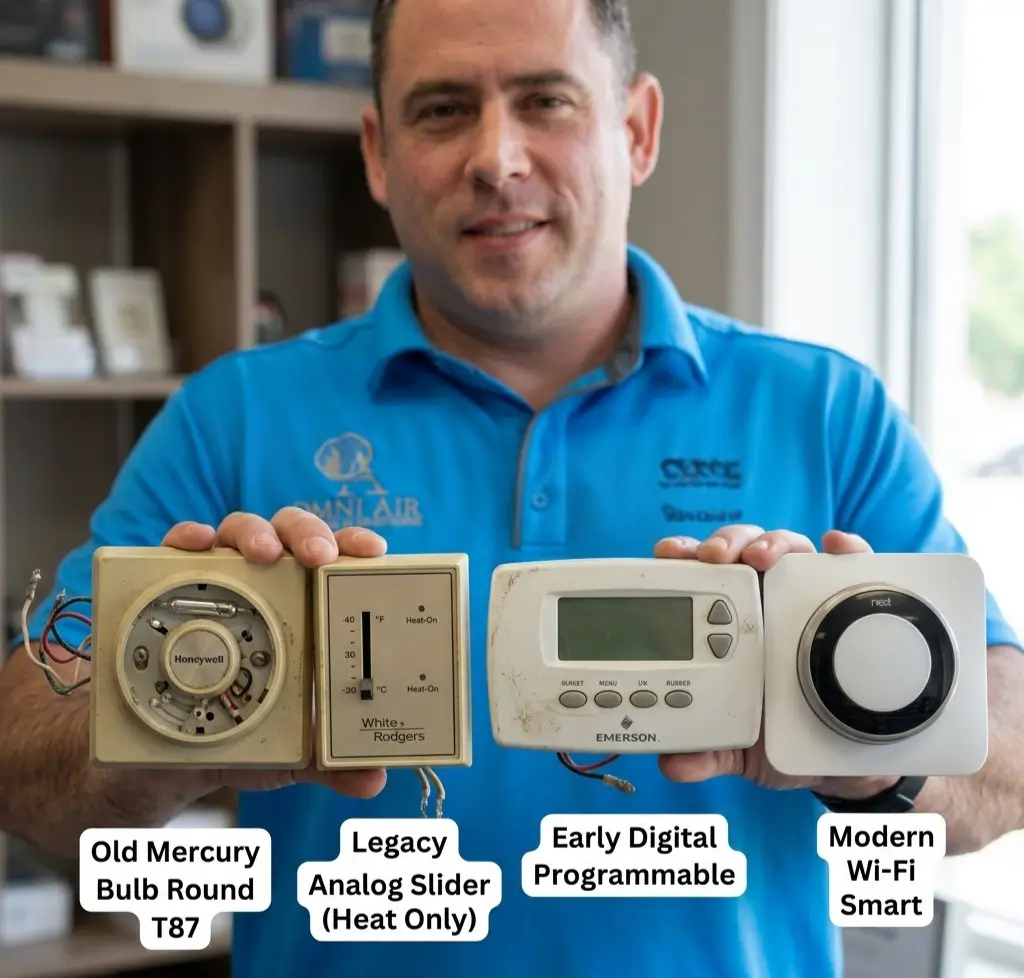
4 Kinds of Thermostats I Find on Montgomery County Walls
People use these three words as if they mean the same thing. The difference decides whether the upgrade is worth your money.
| Type | What it does | Who it fits |
| Manual | One dial or one set of buttons. Holds whatever you last set. No schedule, no data. | Nobody, at this point. This is where the biggest savings jump comes from. |
| Programmable | Runs a schedule you enter by hand. No Wi-Fi, no app, no reporting. | Fine if you set it once and truly leave it alone. Most people override it and lose the benefit. |
| Smart (Wi-Fi) | App control, auto scheduling, remote sensors, runtime reports, utility program enrollment. | Single stage and standard two stage systems. This is the category most homeowners mean. |
| Communicating | Matched control that talks to the equipment over a data bus. Made by your system manufacturer. | Variable speed and high efficiency systems. A third party smart thermostat can cripple these. |
What the Independent Data Says, and What the Box Says
There are two sets of numbers here: the federal ones, and the marketing ones. I only use the first set with customers.
The EPA runs the certification program, and its smart thermostat FAQ states that “savings are approximately 8% of heating and cooling bills or $50 per year” for the average certified unit (ENERGY STAR). That number is worth trusting because these are not certified in a lab. Manufacturers submit a year of field data from hundreds of customer homes.
The Department of Energy comes at it from the other direction. Its home upgrades guidance says you can save as much as 10 percent a year by “turning your thermostat back 7°-10°F for 8 hours a day” from your normal setting (U.S. Department of Energy). A smart thermostat does not invent savings. It makes that setback happen daily without you remembering.
Brand claims run higher. Nest publishes 10 to 15 percent and ecobee has cited north of 20 percent. Those come from company marketing, not independent verification, and I do not quote them.
One number matters more here than any national average. EIA survey data puts air conditioning at 27 percent of home energy spending in the hot humid climate region that includes Montgomery County, with 94 percent of households running it. Cooling is a bigger slice of your bill here than in the states where most thermostat reviews get written, so an 8 percent cut lands on a bigger number.
What I Measured on Real Montgomery County Homes
Here is what I recorded. I pull runtime reports at follow up visits, which is cleaner than comparing bills because it strips out weather swings and rate changes. Three homes I set up myself, tracked across a full cooling season.
| Home | What it Replaced | Daily Cooling Runtime before | After (Same season, following year) | What made the Difference |
| 2005 two story, Willis, 4 ton single stage | Manual, held at 74 all summer | 12.5 hrs/day avg, July | 8.8 hrs/day avg, July | Schedule plus a remote sensor upstairs. The hallway sensor had been lying about the second floor. |
| 1990s ranch, Conroe, 3 ton with attic air handler | Programmable the owner overrode daily | 9.9 hrs/day avg, July | 9.2 hrs/day avg, July | Smaller gain. The programmable was already close. Most of the benefit was remote control and alerts. |
| Bentwater, retired couple home all day | Working 7 day programmable, used correctly | 10.3 hrs/day avg, July | 10.2 hrs/day avg, July | Essentially no change. Nobody is ever away, so there is nothing to set back. I told them to keep their money. |
That table is the whole answer to the question in the title. Savings do not come from the thermostat being smart. They come from the gap between how you ran your system and how it should have run. A manual thermostat held at one number all summer leaves a lot on the table. A well used programmable leaves very little.
The Montgomery County Angle Nobody Else Writes About: You Are Not on ERCOT
I have never seen this in a national smart thermostat article, and it changes the math here.
Most of Montgomery County is served by Entergy Texas. Entergy Texas sits on the MISO grid, not ERCOT, and it is a regulated utility, which means you cannot shop retail electricity plans the way a Houston or Dallas homeowner can. Every article telling you to pair a smart thermostat with a time of use plan and shift cooling to cheap hours is writing for somebody else. That option is not on your table.
Coverage is not uniform. Parts of the county fall under Mid-South Synergy and Sam Houston Electric Cooperative, and the southern edge of The Woodlands, including Creekside Park, is CenterPoint on ERCOT. Check the name on your bill first.
The Entergy Texas Demand Solutions Program
Here is the part worth money. Entergy Texas runs a demand response program for smart thermostats. You enroll, you agree to let Entergy make brief, small adjustments during peak demand, and you get paid. As of this writing it pays a $25 virtual prepaid card at enrollment and another $25 per thermostat at your 12 month anniversary. You can opt out of any individual adjustment from the thermostat or your phone.
Enrollment paths exist for Nest, ecobee, Sensi, Honeywell Home, Honeywell TCC, and Amazon devices, so device choice matters if you want the money. The adjustments are small and brief. The customers who complained were the ones nobody warned, not the ones who were uncomfortable.
Amounts and eligible devices change, so confirm both on the Entergy Texas residential efficiency page and the ENERGY STAR rebate finder before you buy.
Where Smart Thermostats Fail in Montgomery County Homes
These are the situations that turn a good upgrade into a callback. Every one is something I have walked into on a real job.
1. There Is No C-Wire Behind the Plate
A smart thermostat needs constant low voltage power. Older homes here were often wired with four conductors and no common wire. Some models ship with a power extender kit and some do not. Pulling the plate and counting wires takes ten seconds and saves a return trip. No C-wire and no adapter means new cable through the wall, which is a real job.
2. The System Is Communicating and the Thermostat Is Not
This is the expensive mistake. ENERGY STAR says it plainly in its own technical bulletin on smart thermostats: for variable speed equipment, “the thermostat recommended by the equipment manufacturer should be used” (ENERGY STAR technical bulletin, PDF). Put a generic thermostat on a communicating variable speed system and you can knock it down to single speed. You paid for a high SEER2 rating and threw away the reason it is high, along with the low speed dehumidification that makes a Texas summer bearable indoors.
3. You Have a Heat Pump and Nobody Set the Aux Lockout
A big setback recovery on a heat pump can trigger electric strip heat, the most expensive way to warm a house here. If you run a heat pump instead of a straight air conditioner, the installer has to set the auxiliary heat lockout and the recovery ramp. Out of the box, most of these will happily burn strip heat to hit your morning setting. That is not savings, that is a bigger bill wearing a nice screen.
4. The Thermostat Is in the Hallway and the Problem Is Upstairs
This is specific to how homes are built here. The air handler sits in the attic, the return is in the hall ceiling, and the thermostat reads downstairs hallway air that has nothing to do with the upstairs bedrooms. In August that gap is significant. Remote sensors fix it, and they are the most underused feature on these devices. If your AC runs and runs without cooling the house down, sensor placement is one of the first things I check.
5. Weak Wi-Fi, or a Zoned System With One Thermostat
A smart thermostat with no connection is an expensive programmable. This comes up in larger properties, especially homes around Lake Conroe, so I check signal at the wall before selling the job. Zones are the other version. If you have a zoned system, every zone needs its own compatible control, and one thermostat wired into a zone panel creates more problems than it solves.
6. The Real Problem Is Airflow, Not Control
A thermostat cannot fix a restricted system. If your dirty filter has not been changed since spring, or ducts are leaking into a 130 degree attic, a new control just gives you a prettier view of a struggling system. I would rather sell an hour of HVAC maintenance than a thermostat that papers over an airflow problem.
What I Got Wrong at First
I did not start out good at this. Three misses that cost me callbacks.
I sold geofencing too hard.
Early on I set aggressive away settings, letting the house drift to 82 while everyone was out. In a mild climate that works. Here in August a 4 ton system then runs two hours straight during the worst heat of the day, the house stays humid, and the owner is uncomfortable until evening. Now I cap the summer away setback at three or four degrees.
I installed one on a communicating system without checking the data plate.
The customer had a high efficiency variable speed unit. The new thermostat worked, the house got cold, and two weeks later she called about humidity. I had knocked her system down to one speed and put the original control back at my own cost. Now the data plate is the first thing I read on any thermostat quote.
I trusted the app’s savings screen
The in-app estimate compares your runtime to the thermostat’s own model of what you would have used, not to your bill. I quoted one and could not back it up when the homeowner’s bill went the other way after a rate increase. Now I only show raw runtime hours. Runtime is a fact. The savings screen is a projection.
My Installation Checklist, Step by Step
This is the order I work in on every install. Each step exists because it is a mistake I made once.
- Read the data plate on the air handler and condenser. Single stage, two stage, heat pump, or communicating. This decides the job.
- Photograph the wiring before touching a terminal, and confirm a C-wire or a workable adapter.
- Check filter and static pressure. A restricted system gets fixed first, or the new control just logs the problem.
- Test Wi-Fi signal at the thermostat location, not at the router.
- Set compressor minimum off time to five minutes so short cycling cannot damage it.
- Configure heat pump aux lockout and recovery ramp where applicable.
- Cap the summer away setback at three to four degrees and build the schedule around the family’s real day.
- Place remote sensors in the rooms that matter, usually the upstairs bedrooms.
- Run a full cycle and confirm every stage energizes, including second stage cooling.
- Walk the homeowner through the app and Entergy Demand Solutions enrollment before I leave.
So Is a Smart Thermostat Worth It in Montgomery, Texas?
Here is how I sort it on the truck.
| Your situation | My call | Why |
| Manual thermostat, house empty during work hours | Worth it | Biggest gain available. You are going from zero setback to a daily schedule you never have to think about. |
| Programmable you override every day | Worth it | Auto scheduling and geofencing close the gap between what you programmed and what you actually do. |
| Two story home with a hot upstairs | Worth it, with sensors | Remote sensors are the real fix. The thermostat is just what makes them possible. |
| Someone home all day, every day | Marginal | There is no away period to set back. You are buying convenience and alerts, not savings. |
| Programmable you already use correctly | Marginal | Your savings are mostly captured. Expect small gains plus remote control and runtime data. |
| Variable speed communicating system | Use the manufacturer control | A third party thermostat can cost you staging and dehumidification. Match the equipment. |
| System with an airflow or duct problem | Fix that first | A new control will not move more air. Diagnose the system, then add the thermostat. |
| System is already 15 years old | Wait and bundle it | If replacement is close, the thermostat should be specified with the new equipment, not before it. |
That last row matters. If your system is already 15 years old, a control bought now can be money spent twice. When we quote AC installation, the thermostat is specified with the system so the control and equipment match, and HVAC financing options make bundling easier.
Why Choose Omni Air & Heating LLC for HVAC Solutions
Omni Air & Heating LLC is a local, licensed HVAC company in Montgomery, Texas, license number TACLA105873C. Here is what that means when you call about a thermostat.
- We check the equipment before recommending a control. Data plate first, catalog second. That habit prevents the most expensive mistake in this category.
- We configure it, not just mount it: aux lockout, staging, minimum off time, sensor placement, and a real schedule.
- We know which utility you are on, Entergy Texas, Mid-South Synergy, Sam Houston Electric Cooperative, or CenterPoint, and which programs you can enroll in.
- We will tell you not to buy one. If you already run a programmable well, or the system needs duct repair more than a screen, you will hear that.
- Local techs across Montgomery, Conroe, Willis, The Woodlands, Magnolia, Bentwater, Shenandoah, Spring, and the lake communities.
Frequently Asked Questions
Is a smart thermostat worth it in Montgomery, Texas?
It depends on what you are replacing. Coming off a manual thermostat, or a programmable you override daily, the gain is usually real because cooling is such a large share of the bill here. If you already run a programmable well and someone is home all day, you are mostly buying remote control and alerts.
How much does a smart thermostat save in Texas?
The EPA reports about 8 percent of heating and cooling costs for the average certified unit. Air conditioning is a bigger share of the bill in the hot humid region that includes Montgomery County, so that percentage applies to a larger number here.
Does Entergy Texas pay you to use a smart thermostat?
Yes. The Entergy Texas Demand Solutions program pays a prepaid card at enrollment and another at your 12 month anniversary, in exchange for letting Entergy make brief, small adjustments during peak demand. You can opt out of any event from your phone. Confirm current amounts before you buy.
Can I install a smart thermostat myself?
Many people can, if there is a C-wire and the system is standard single stage. The two things that go wrong are a missing common wire and equipment mismatch. Photograph the old wiring and read the data plate on your air handler first. If the system is variable speed or communicating, do not use a third party thermostat.
What is a C-wire and why does it matter?
The C-wire, or common wire, delivers continuous low voltage power. Smart thermostats need it because they run a screen and a Wi-Fi radio all day. Older Montgomery County homes were often wired without one. Some models include a power extender kit, and some require new thermostat cable.
Will a smart thermostat work with my heat pump?
Yes, if it is set up correctly. The main risk is auxiliary electric heat coming on during a large setback recovery, which is expensive. Whoever installs it has to configure the aux lockout and recovery ramp for your equipment.
Final Thoughts
A smart thermostat does not make your air conditioner more efficient. It makes you more consistent. That is the whole product. If there is a gap between how your system runs today and how it should run, the device closes it automatically, and in a county where cooling drives the bill for most of the year, that gap is worth real money.
If there is no gap, or the equipment needs a matched control, the honest answer is keep your money. I would rather say that on the first visit than sell you something you call me about in August.
If you want somebody to look at your wiring and your equipment before you buy, Omni Air & Heating LLC is a call away at (281) 767-6664.
- How to Prepare Your HVAC System for a Montgomery TX Winter
- Air Duct Cleaning Montgomery TX: Do You Actually Need It?
- Mold and Your HVAC System: What Montgomery TX Homeowners Need to Know
- HVAC Tips for New Homeowners in The Woodlands TX: A Tech’s First-Year Plan
- AC Allergens: How to Reduce Pollen and Dust in Your Texas Home

Joseph Miller is the owner and lead Heating & Air Conditioning Specialist at Omni Air & Heating LLC, proudly serving Montgomery, Texas and surrounding communities since 2020. Joseph brings hands-on experience diagnosing, repairing, and installing residential and light commercial heating and cooling systems. His expertise includes air conditioning systems, heat pumps, furnace repair, system replacements, ductless mini splits, and indoor air quality solutions designed for the unique climate conditions of Southeast Texas.
0 Comments