
By Joseph Miller | HVAC Technician & Owner, Omni Air & Heating LLC
Walk through enough Texas homes and you start hearing the same complaint over and over, one part of the house is freezing while another still feels like an oven at 9 PM. The system runs constantly. The bills climb. And nobody’s actually comfortable.
I’ve been doing HVAC work in Texas long enough that this conversation comes up on almost every service call during summer. Nine times out of ten the problem isn’t the equipment. It’s that one thermostat is trying to manage a house it can’t fully read.
That’s where a zoned HVAC system comes in, not as a gimmick, but as a real fix for a real problem.
What a Zoned HVAC System Actually Is
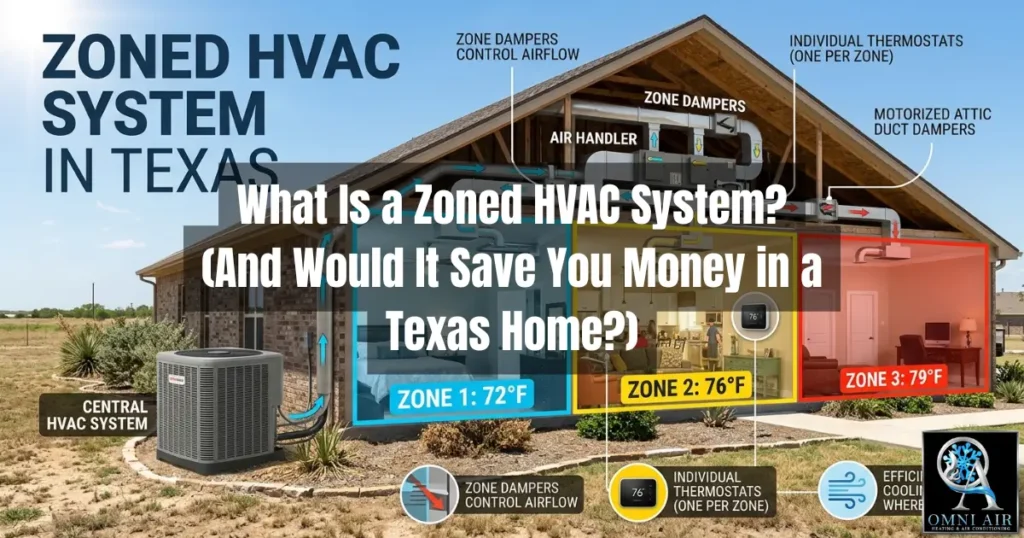
A zoned HVAC system divides your home into two or more independently controlled areas called zones, each with its own thermostat. Instead of the whole house responding to a single sensor in the hallway, each zone calls for heating or cooling based on its own temperature readings.
The Hardware Behind It
The system runs on motorized dampers installed inside your ductwork. These panels open and close in response to each zone’s thermostat signal. A central control board coordinates everything. Setups that run multiple zones at different levels also include a bypass damper to manage air pressure when only part of the system is active.
Pair this with smart thermostats and you can schedule each zone independently, the home office stays cool during work hours, the guest bedroom barely runs until the weekend.
How It Differs from a Standard Single-Zone Setup
In a typical single-zone setup, one thermostat controls the whole house. When it calls for cooling, the system runs until that one sensor is satisfied, regardless of what’s happening in the rest of the home. With zone control, you’re conditioning only the spaces that need it, only when they need it. That changes both the comfort picture and the energy equation.
Why Texas Homes Are a Natural Fit for Zoning
Texas summers are genuinely punishing. Sustained heat in the upper 90s for weeks at a stretch, with humidity across much of the state, means your AC doesn’t get a real break between June and September and often into October.
Layer on top of that how many Texas homes are built: two-story layouts, large square footage, open floor plans, and a lot of south and west-facing glass. Heat rises. Rooms with heavy afternoon sun exposure heat up at entirely different rates than north-facing spaces. Upstairs bedrooms in Texas homes can run 8–10 degrees warmer than the ground floor even in a properly maintained system.
The U.S. Department of Energy has reported that zoning can reduce heating and cooling costs by up to 30 percent in homes with significant temperature variation between areas. In Texas, with a cooling season stretching seven to eight months, that translates to real money.
Which Homes Benefit Most from HVAC Zoning
Zoning isn’t the right call for every home, and I’d rather be straight about that upfront.
The strongest candidates are homes with:
- Multiple stories where heat stratification is a constant issue
- Square footage over 2,000 sq ft where a single thermostat can’t accurately represent conditions across the whole space
- Rooms with mismatched sun exposure, bonus rooms over garages, sunrooms, or areas with large west-facing windows
- Areas on different use schedules, a home office occupied all day, guest bedrooms that sit empty most of the week
- Additions or problem rooms where extending ductwork isn’t practical (a ductless mini-split may be the smarter zone solution there)
If you’re in a single-story, well-insulated 1,100 sq ft home, zoning probably won’t deliver enough savings to justify the install cost. That’s something I’ll tell you on the initial call.
What Does It Cost And Do the Savings Actually Work Out?
Here’s a realistic cost range for Texas homeowners:
- 2-zone system: $2,500–$4,500 installed on an existing system with accessible ductwork
- 3 to 4 zones: $4,000–$7,500+
- New construction or significant ductwork modifications: Higher, depending on layout
Based on what I see in the field, homeowners who consistently zone out unused areas save $300–$700 per year on energy costs. At that rate, most systems pay back the installation within 5–8 years, well within the 15–20-year service life of well-maintained equipment.
There’s also an ERCOT angle worth mentioning. Texas grid demand peaks on hot afternoons. Running a more targeted, efficient system is good for your bill and helps reduce strain during those high-demand windows when grid pressure is highest.
Why Choose Omni Air & Heating LLC for HVAC Solutions
Zoning isn’t a plug-and-play installation. Damper sizing, duct pressure calculations, and control board configuration all have to be done correctly, or you end up with pressure noise, uneven temperatures, and a system that short-cycles.
At Omni Air & Heating LLC, we base every zoning job on a Manual J load calculation, no guesswork on damper sizes or bypass settings. We handle thermostat integration whether you want standard programmable units, smart home compatibility, or both.
Our team is licensed, background-checked, and we pull permits where required. We work across the Texas service area with full installation, zoning retrofits, and complete system upgrades.
If you’re considering a system replacement, zoning is usually easiest and most cost-effective when built into a new AC installation rather than retrofitted onto aging equipment. Reach out and we’ll walk through whether your home is a good candidate.
Frequently Asked Questions About Zoned HVAC Systems
Can I add zoning to my existing HVAC system?
In most cases, yes. If your ductwork is accessible and in reasonable condition, a zoning panel and motorized dampers can be retrofitted without replacing the full system. A load analysis beforehand confirms whether it’s a solid candidate.
How many zones does my Texas home actually need?
Most homes work well with 2–3 zones. A common layout: main living areas on one zone, upstairs bedrooms on a second, and a bonus room or home office as a third. Adding more zones beyond that tends to add cost without a proportional benefit, the goal is matching zones to how you actually use the house.
Does a zoned HVAC system work with a heat pump?
Yes, and heat pumps are actually a strong pairing. Variable-speed or two-stage heat pumps handle varying zone demands more smoothly than single-stage equipment, making the combination efficient and consistent.
Will HVAC zoning help with humidity problems in Texas?
Partially. Zoning reduces runtime in unused areas, which affects how long the system runs in dehumidification mode. For chronic humidity issues, a whole-home dehumidifier is usually the more direct fix but zoning does contribute to the overall improvement.
Is a ductless mini-split the same as a zoned HVAC system?
Not exactly, though both achieve independent temperature control in different areas. A ductless mini-split creates a conditioned space without ductwork, making it efficient for additions or problem rooms. Some homes combine both ducted zoning for main living areas, mini-splits for challenging spaces.
Final Thoughts
If your Texas home has rooms that run perpetually hot or cold, energy bills that seem out of proportion to your actual usage, or spaces that sit empty most of the week, a zoned HVAC system is worth a genuine conversation. It won’t solve every HVAC problem, but when the fit is right, the difference shows up in your comfort and your bill from the first month.
Reach out if you want an honest assessment of whether your home is a good candidate. We’ll work through the numbers with you, no pressure, no upsell on things you don’t need.
Recent Articles:
- HVAC Maintenance Checklist for Montgomery TX Homeowners: Spring & Fall Tune-Up
- What Is a Smart Thermostat and Is It Worth It in Montgomery, Texas?
- Signs Your Ductwork Needs Repair or Replacement in a Texas Home
- Indoor Air Quality in Montgomery County TX: A Homeowner’s Complete Guide
- How to Change Your AC Filter in Texas (And How Often)

Joseph Miller is the owner and lead Heating & Air Conditioning Specialist at Omni Air & Heating LLC, proudly serving Montgomery, Texas and surrounding communities since 2020. Joseph brings hands-on experience diagnosing, repairing, and installing residential and light commercial heating and cooling systems. His expertise includes air conditioning systems, heat pumps, furnace repair, system replacements, ductless mini splits, and indoor air quality solutions designed for the unique climate conditions of Southeast Texas.
0 Comments