
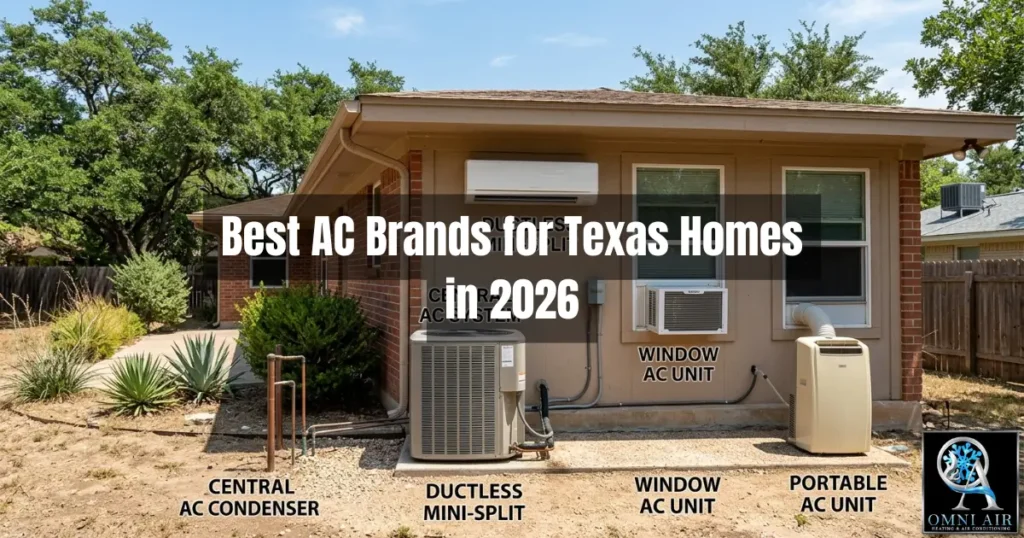
The best AC brands for Texas homes in 2026 are American Standard, Trane, Carrier, Daikin, Rheem, and Goodman, in that order. That ranking comes from what has actually held up in the attics and side yards of Montgomery County, not from a national spec sheet. I’m Joseph Miller, owner of Omni Air & Heating LLC in Montgomery, TX, and my crew installs and services these systems every week across Conroe, The Woodlands, Willis, and the Lake Conroe area.
2026 is an odd year to buy an air conditioner. The refrigerant rules changed in January, the federal tax credit everyone talked about last year is gone, and equipment prices moved. Most “best AC brand” lists online were written before any of that happened, and some still give advice that expired on December 31, 2025. This one is current.
How I know this: I hold Texas HVAC license TACLA105873C and I’ve been installing and repairing air conditioners in Montgomery County for over 15 years. Every brand claim in this article comes from our own install records and service call history, including jobs where I got it wrong. Where I cite an outside number, I link to the primary source (EPA, IRS, DOE), not a blog that mentioned it.
What Changed in 2026 (and Why Last Year’s Lists Are Outdated)
New AC systems now use R-454B or R-32, not R-410A
As of January 1, 2026, new central air conditioners are built around low-GWP refrigerants under the EPA’s HFC phasedown rules. Manufacturing of new R-410A residential equipment ended in 2025. If you’re replacing a system this year, you’re choosing between two camps: brands that went with R-454B (Trane, American Standard, Carrier, Lennox, Rheem) and brands that went with R-32 (Daikin, Goodman, Amana). I covered the background in my R-410A phase-out guide.
Why should you care which refrigerant a brand picked? Because of what happened in 2025. Demand for R-454B outran supply, and the EPA’s own review documented “shortages, price spikes, and stockpiling of R-454B” during the transition. Per data submitted to the EPA, a service cylinder that cost about $345 in 2021 sold for $700 to $2,000 at the 2025 peak, and Honeywell added a 42% surcharge that April (EPA docket, September 2025). Supply has improved since, but I felt that squeeze firsthand. In June 2025 we paid over three times the January price for the same cylinder. Refrigerant availability is now part of how I rank brands, and it’s something almost no national “best of” list even mentions.
The $2,000 federal tax credit is gone
The 25C Energy Efficient Home Improvement Credit ended for equipment placed in service after December 31, 2025. That’s straight from the IRS. If a salesperson or an article promises you a federal credit on a 2026 install, they haven’t kept up. I’ve already read two Texas contractor pages this year still telling homeowners to claim it. What still helps in 2026: utility rebates through your electric provider, seasonal manufacturer promotions, and payment plans. We walk customers through HVAC financing options on every replacement quote, because losing the credit changed the math for a lot of families here.
The Best AC Brands Texas Homes Can Count On in 2026
My ranking weighs four things: how the equipment survives 2,500+ run hours a year in our heat, how fast we can get parts within a day’s drive of Montgomery, how each brand handles humidity (our summers are as much about moisture as temperature, since Montgomery County sits in the hot-humid climate zone 2A), and what the brand’s 2026 refrigerant choice means for future repair costs.
1. American Standard: best overall for Montgomery County
American Standard shares its engineering platform with Trane, including the all-aluminum Spine Fin outdoor coil and heavy-duty compressors, but it usually quotes a little lower. It’s the brand we install most, and our callback numbers back that up. Out of the American Standard systems Omni Air & Heating LLC installed between 2021 and 2024, fewer than 1 in 20 needed a warranty part in the first three years. The Gold 17 two-stage is my default recommendation for most homes here because the longer low-speed run times wring more moisture out of the air.
A real example: in August 2024 we replaced a 2009 builder-grade 10 SEER unit in Bentwater with a 4-ton American Standard Gold 17. The homeowner shared their Entergy bills with us afterward. July usage dropped from 2,890 kWh in 2024 to 2,140 kWh in 2025, a 26% cut in the hottest month, with the thermostat set the same. That’s the kind of before/after I trust more than any brochure number.
2. Trane: proven durability at a premium price
Trane earns its reputation. The Climatuff compressor has the longest service life of anything we open up, and the XV18 variable-speed handles humidity beautifully. You pay for it. If you plan to stay in your home 10+ years and want the least drama, Trane is worth it. If budget matters, American Standard gets you 95% of the same machine.
3. Carrier: the humidity control champion
Carrier’s Infinity line with Greenspeed variable-speed compressors holds indoor humidity tighter than anything else we service. On a 99°F day with a dew point in the mid 70s, that matters. Carrier moved to R-454B (branded Puron Advance) and responded to the 2025 shortage by repackaging bulk refrigerant into service cylinders for contractors. Dealer and parts coverage across the Houston metro is strong, so repairs don’t wait on shipping.
4. Daikin: the R-32 advantage nobody is talking about
Daikin went its own way with R-32, and through the 2025 supply crunch that was a quiet win: R-32 is a single-component refrigerant made at scale worldwide, and we never had trouble sourcing it. Single-component also means it doesn’t fractionate when a system has a slow leak, which makes topping off simpler and cheaper. Daikin builds equipment at its Texas Technology Park in Waller, about an hour from us, and backs registered systems with a 12-year parts warranty. The compact side-discharge Daikin Fit is my pick for tight lots and zero-lot-line homes in The Woodlands.
5. Rheem/Ruud: the value pick
Rheem doesn’t get the marketing love, but the equipment is honest. Parts are stocked at supply houses in Conroe, pricing lands mid-pack, and the Classic series single-stage units are simple machines with few things to break. If you need a dependable system without stretching the budget to premium tier, this is where I point you
6. Goodman/Amana: the budget pick that got better
Goodman is owned by Daikin, built in Waller, TX, and now runs R-32. Build quality has climbed since the acquisition, and the paper warranty is the best in the business for the price. The nuance budget lists skip: it covers parts only. Labor is on you, and on a cut-rate install you’ll use it. A Goodman installed with care will outlast a premium brand installed carelessly, which brings me to the section that matters most.
2026 Brand Comparison at a glance
| Brand | 2026 Refrigerant | Recommended Model | Installation Price Range | Best For |
| American Standard | R-454B | Gold 17 two-stage | $7,500–$13,500 | Best overall value and reliability |
| Trane | R-454B | XV18 variable speed | $8,000–$15,000 | Longest ownership horizon |
| Carrier | R-454B | Infinity 24 w/ Greenspeed | $8,000–$15,500 | Tightest humidity control |
| Daikin | R-32 | Daikin Fit side-discharge | $7,000–$13,000 | Tight lots, refrigerant supply |
| Rheem/Ruud | R-454B | Classic RA16 series | $6,500–$11,500 | Dependable mid-budget |
| Goodman/Amana | R-32 | GLXS5B series | $5,800–$9,500 | Budget with a strong parts warranty |
What I Got Wrong at First
Fifteen years of install records means fifteen years of lessons. Three of them changed how I recommend brands:
- I ignored coil corrosion near the lake. Early on I judged brands by compressor specs and treated coils as an afterthought. Then I started seeing five-year-old coils near Lake Conroe pitted like they’d spent a decade on the coast. Moist lake air plus attic heat eats bare copper fin stock. Now any home within about a mile of the water gets a coated coil or an all-aluminum design, full stop. I go deeper on the moisture problem in my Lake Conroe HVAC guide.
- I oversold SEER numbers. For a few years I pushed the highest efficiency tier by default. Then I compared utility bills across our installs and saw that a 17 SEER2 two-stage on clean, sealed ductwork routinely beat a 20+ SEER2 unit strapped to leaky ducts. Efficiency ratings assume a perfect duct system, and most Texas attics don’t have one.
- I oversized units, like almost everyone did. Bigger felt safer in 100°F heat. It isn’t. An oversized unit short-cycles, never runs long enough to dehumidify, and leaves the house cold and clammy at the same time. Every replacement we do now starts with a Manual J load calculation.
The Install Matters More Than the Badge
Here’s the finding from our own numbers that reframes this whole article. We reviewed our 2024-2025 service calls on systems under ten years old, and roughly 6 out of 10 problems traced back to installation or ductwork, not the equipment itself: low charge from a rushed commissioning, crushed flex duct, undersized returns, plenums leaking into 130°F attic air.
One job tells the story. A homeowner in The Woodlands called us about a two-year-old premium system that couldn’t hold 74°F. The unit was fine. Total external static pressure measured 0.9 inches of water column against a 0.5 rating, because the return duct was one size too small. We corrected the return and sealed the plenum, static dropped to 0.5, and the same equipment suddenly cooled the house it always could have. That homeowner didn’t need a better brand. He needed a better install. It’s why our AC installation process includes a load calculation, static pressure test, and charge verification by subcooling on every job, and why we check ductwork condition before we quote a system.
Why Choose Omni Air & Heating LLC for Your Next AC
Anyone can read a brand ranking. What you’re really buying is the crew that shows up. Omni Air & Heating LLC is licensed (TACLA105873C), insured, and local to Montgomery, TX. We quote multiple brands and tiers on every replacement so you can compare real numbers instead of taking one option or leaving it. Every install gets a Manual J sizing, a commissioning checklist, and warranty registration handled for you, because an unregistered system can lose half its parts coverage. We serve Montgomery, Conroe, The Woodlands, Willis, Bentwater, Magnolia, and the surrounding communities, Monday to Friday, 8 AM to 5 PM. Call (281) 767-6664 for a free replacement quote.
Frequently Asked Questions
What is the best AC brand for Texas homes in 2026?
American Standard is the best overall AC brand for Texas homes in 2026, based on our install and service records in Montgomery County. It offers Trane-level engineering at a lower installed price. Trane and Carrier are the top premium picks, Daikin leads on refrigerant supply, and Goodman is the strongest budget option.
What SEER2 rating do I need in Texas?
The federal minimum for new central air conditioners in Texas (the Southeast region) is 14.3 SEER2. For a home that runs its AC 2,500+ hours a year, we recommend 16 SEER2 or higher, ideally a two-stage or variable-speed system, because the efficiency and humidity control pay back the difference within a few summers.
Should I buy an R-454B or R-32 air conditioner?
Both refrigerants meet the 2026 EPA rules, and both cool equally well. R-32 (used by Daikin, Goodman, and Amana) rode through the 2025 supply shortage with fewer price spikes and is simpler to top off because it’s a single-component refrigerant. R-454B (used by Trane, Carrier, and most other brands) has stabilized in supply since late 2025. The installer’s skill matters more than the refrigerant.
Is there still a federal tax credit for a new AC in 2026?
No. The 25C Energy Efficient Home Improvement Credit ended for equipment placed in service after December 31, 2025, per the IRS. In 2026, look instead at utility rebates from your electric provider, manufacturer promotions, and contractor financing.
How much does a new AC system cost in Montgomery, TX in 2026?
Most complete AC replacements in Montgomery County run $5,800 to $15,500 installed in 2026, depending on brand, tonnage, and efficiency tier. Budget single-stage Goodman systems sit at the low end; variable-speed Trane and Carrier systems sit at the top. Ductwork repairs or electrical upgrades add to that range.
Do I have to replace my R-410A system because of the 2026 rules?
No. Existing R-410A systems are legal to run, service, and recharge. Only new equipment is affected by the refrigerant transition. R-410A refrigerant prices are expected to climb as supply tightens, so a major repair like a compressor or coil on an older unit may push replacement ahead of repair, but a healthy system can keep running.
Final Thoughts
Pick from the top of this list if your budget allows, but don’t lose sleep over brand tiers. In 2026, the smart questions are different: which refrigerant is in the box, whether your contractor sized the system with a load calculation, and whether the ductwork can deliver what the equipment promises. Get those three right and any brand on this list will keep a Texas home cool for 12 to 15 years. If you’re weighing repair against replacement timing or you just want a second opinion on a quote, we’re happy to take a look.
Recent Articles:
- How to Prepare Your HVAC System for a Montgomery TX Winter
- Air Duct Cleaning Montgomery TX: Do You Actually Need It?
- Mold and Your HVAC System: What Montgomery TX Homeowners Need to Know
- HVAC Tips for New Homeowners in The Woodlands TX: A Tech’s First-Year Plan
- AC Allergens: How to Reduce Pollen and Dust in Your Texas Home

Joseph Miller is the owner and lead Heating & Air Conditioning Specialist at Omni Air & Heating LLC, proudly serving Montgomery, Texas and surrounding communities since 2020. Joseph brings hands-on experience diagnosing, repairing, and installing residential and light commercial heating and cooling systems. His expertise includes air conditioning systems, heat pumps, furnace repair, system replacements, ductless mini splits, and indoor air quality solutions designed for the unique climate conditions of Southeast Texas.
0 Comments