
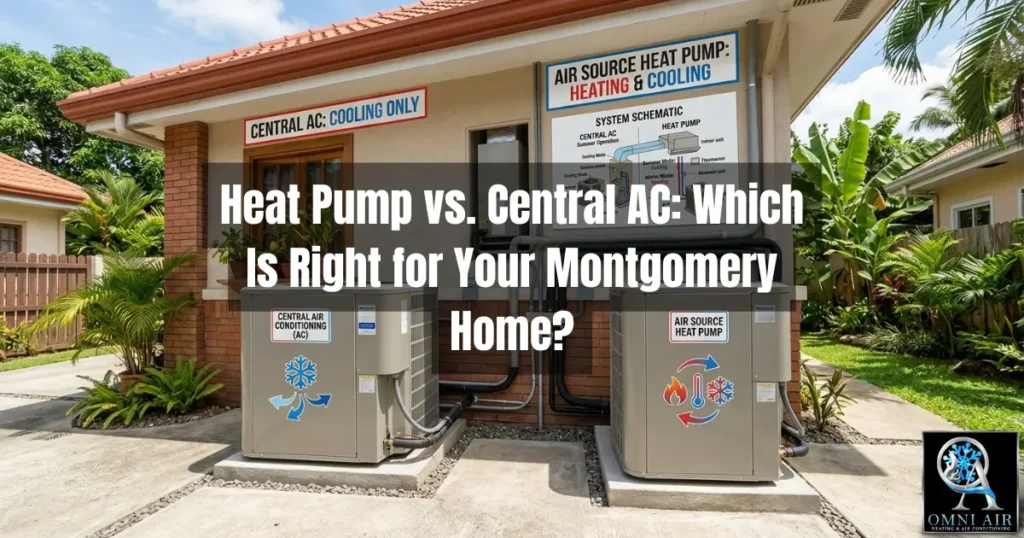
If you are replacing your system this year, the choice usually comes down to two paths. You can install a heat pump that both heats and cools from one outdoor unit, or a central air conditioner paired with a separate furnace. I get asked which one is “better” almost every week on service calls around Montgomery, Conroe, and Willis. The honest answer is that it depends on your house, your ductwork, and whether you already own a furnace worth keeping.
Most of the articles you will find on this exact question were written for Dallas or San Antonio. Our corner of Texas is different. We sit next to Lake Conroe with humidity that hangs around most of the year, and that changes the math in ways those guides skip. So I want to walk through the real trade-offs the way I explain them at a kitchen table, including a few things I got wrong early in my career.
How I know this: I run install and repair calls for Omni Air & Heating LLC here in Montgomery County. I have personally swapped out both straight-cool AC systems and heat pumps in homes from Shenandoah up to Willis for 35 years. The comparisons below come from what I actually see when I pull a panel, not from a spec sheet.
Heat Pump vs. Central AC: In Summer, They Are Nearly the Same Machine
This is the part that surprises people, so I lead with it. A heat pump and a central air conditioner cool your home using the exact same process. Both use a compressor, refrigerant, and coils to move heat out of your house and dump it outside. In cooling mode, a heat pump is an air conditioner. The efficiency ratings even prove it: a heat pump’s cooling efficiency is measured in SEER2, the same scale used for an AC.
So where do they split? Heating.
A central AC does one job. It cools. When winter comes, it shuts off and a separate furnace (usually gas here in Montgomery County) takes over. A heat pump adds one part, a reversing valve, that lets it run backward. In winter it pulls heat out of the outdoor air and moves it inside. It does not burn anything to make heat. It moves heat that already exists, which is why it uses so little energy to do it.
That single difference drives the entire decision. You are really choosing between one box that does both jobs, or two systems that split the work.
Why This Choice Is Different in Montgomery County Than in Dallas
Here is what almost every other guide misses. They treat “Texas” like one climate. It is not. Up in North Texas the air is drier and winters bite a little harder. Down here, our comfort battle is humidity, not just heat.
A properly sized system in our area has to pull a lot of moisture out of the air, not only lower the temperature. This matters for the heat pump vs. central AC question because of how the equipment runs. Modern heat pumps almost always come with variable-speed compressors that run long and slow. Long, slow run times are exactly what wrings humidity out of the air. A cheaper single-stage AC blasts cold, hits the thermostat number fast, and shuts off before it has removed much moisture. The result is a house that reads 72 on the thermostat but still feels clammy.
On the cost side, our winters are mild enough that a heat pump rarely struggles. Most of Montgomery County buys power delivered through CenterPoint Energy, and the statewide residential average sat around 16 to 17 cents per kilowatt-hour in early 2026, according to the U.S. Energy Information Administration. At those rates, running a heat pump through a Texas winter is cheap compared with the electric-resistance heat found in a lot of all-electric homes out here.
The Real Cost Comparison (Including the Part Most Articles Get Wrong)
Upfront
A heat pump usually costs more than an AC unit alone. But that is not a fair comparison. If you go with a central AC, you also need a furnace. When you price the AC and furnace together, a heat pump often lands in the same range or close to it, because you are buying one outdoor unit instead of two systems. If your furnace is already dead or on its last year, the heat pump math gets much friendlier.
Operation Cost
This is where heat pumps earn their keep. The U.S. Department of Energy reports that a modern heat pump can cut the electricity you use for heating by roughly 65% compared with electric-resistance heat. If your home currently heats with electric coils, switching to a heat pump is one of the clearest wins I see in the field.
The 2026 tax-credit change nobody updated their blog for
Now the big one. If you read another comparison this week, odds are it tells you a new heat pump earns a $2,000 federal tax credit. That advice is out of date, and it can cost a homeowner real money to plan around it.
The federal Energy Efficient Home Improvement Credit (Section 25C), the one worth up to $2,000 on a qualifying heat pump, ended for any system placed in service after December 31, 2025. The One Big Beautiful Bill Act, signed in July 2025, moved the expiration up. The IRS states plainly that the credit applies only to property placed in service through the end of 2025, and Energy Star confirms the same cutoff. A heat pump installed in 2026 does not qualify for that federal credit.
That does not mean zero incentives. State and utility rebate programs still change year to year, so I always tell customers to check what their provider currently offers before they sign anything. I would just rather you hear the accurate version now than budget for a $2,000 check from the IRS that is not coming.
One more current-events note: any system you buy today, heat pump or AC, uses the new lower-emission refrigerant (R-454B) that replaced R-410A across new equipment.
What I Got Wrong at First
I will be honest about a few mistakes, because they are the kind of thing you only learn by getting burned.
I used to size systems by the old rule of thumb.
Early on, I sized to square footage and a little gut feel, which usually meant going a size up “to be safe.” In a humid climate, an oversized system is worse, not safer. It cools the air fast, shuts off, and never runs long enough to pull the moisture out. The house feels damp and the equipment short-cycles itself to an early grave. Now I run a Manual J load calculation on every replacement. It takes longer, and it is the single biggest reason a system actually feels comfortable.
I underestimated auxiliary heat.
Heat pumps come with backup electric-resistance strips for the coldest days. On an early install, I did not set the lockout correctly, and during a cold snap those strips ran far more than they needed to. The customer’s bill spiked and they thought the heat pump was broken. It was not. It was the backup coils doing exactly what a misconfigured thermostat told them to. This is also why I warn people never to leave the thermostat on “Emergency Heat” (Em Heat) as a default. That setting forces the resistance strips to run and skips the efficient part of the system entirely.
I assumed a defrosting heat pump was a failing heat pump.
A heat pump occasionally runs a defrost cycle in cold, damp weather and blows cool air for a few minutes while it clears frost off the outdoor coil. It looks and feels like a problem. It is normal. I have talked more than one Conroe homeowner off the ledge over a system that was working perfectly.
None of that shows up on a manufacturer brochure. It shows up on the fifth callback.
When I Recommend a Heat Pump, and When I Don’t
Here is how I actually make the call in a Montgomery County home.
I lean to heat pump: when you are doing a full system replacement anyway, your home is all-electric or has no natural gas line, you are building new, or your existing furnace is old and needs replacing too. In those cases the heat pump usually wins on both upfront and operating cost, and you get one efficient system that handles the whole year. This is also true for room additions and spaces without ductwork, where a ductless mini split heat pump often makes the most sense.
I lean toward keeping AC plus furnace when: your gas furnace is newer and has plenty of life left, and only the AC has failed. In that spot, AC replacement is the cheaper, smarter move. There is no reason to throw out a good furnace.
The quiet winner for gas homes is a dual-fuel (hybrid) setup. You run a heat pump for cooling and for heating on all the mild days, and a gas furnace kicks in automatically only on the rare hard-freeze mornings. You get the efficiency of a heat pump most of the year and the punch of gas heat when we actually need it. It costs a bit more than either system alone, but for a lot of Montgomery County homes it is the best long-term answer.
One edge case worth naming: the February 2021 freeze. When the grid went down, all-electric homes lost heat. That is not really a strike against heat pumps specifically (a gas furnace still needs electricity to run its blower), but it is a good reminder that if you go all-electric, your heat and your grid are tied together. It is a conversation worth having, not a dealbreaker.
Why Choose Omni Air & Heating LLC for Your HVAC Decision
The truth is that the right answer to heat pump vs. central AC is different for almost every house, and a company that quotes you one system without measuring anything is guessing. That is not how we work.
When you call Omni Air & Heating LLC, a licensed Texas technician (our license is TACLA105873C) actually looks at your ductwork, runs a real load calculation, and gives you an honest comparison of both paths with real numbers for your home. We are local to Montgomery and serve Conroe, The Woodlands, Willis, Spring, Magnolia, and the rest of Montgomery County, so we understand our humidity and our winters firsthand.
We also offer flexible HVAC financing so a full-system decision does not have to wait, and every install pairs best with a plan for routine HVAC maintenance to protect it. We do not run 24/7 emergency service, but during business hours we show up, measure, and tell you the truth about what your home needs.
Frequently Asked Questions
Is a heat pump the same as an air conditioner in the summer?
Yes. In cooling mode a heat pump works exactly like a central air conditioner and cools just as well. The only difference is that a heat pump can also reverse itself to heat your home in winter, while an AC cannot.
Does a heat pump work in Texas heat?
Absolutely. Cooling is where heat pumps perform best, and Texas summers are no problem for a properly sized unit. In fact, their long, slow run times often manage our humidity better than a cheaper single-stage AC.
Do I still get a federal tax credit for a heat pump in 2026?
No. The federal Section 25C credit (up to $2,000 for a qualifying heat pump) ended for systems placed in service after December 31, 2025, per the IRS. Check for current state or utility rebates instead, since those change each year.
Which is cheaper to run, a heat pump or an AC with a furnace?
For heating, a heat pump is much cheaper than electric-resistance heat, with the Department of Energy estimating around 65% less electricity used. Against a modern gas furnace it is closer, and depends on gas versus electric prices. For cooling, the two are nearly identical.
Why does my heat pump blow cool air in winter sometimes?
That is a normal defrost cycle. The unit briefly clears frost off its outdoor coil and blows cool air for a few minutes before returning to heating. It is not a malfunction.
Should I keep my furnace if only my AC died?
If your furnace is newer and in good shape, yes. Replacing only the failed AC is usually the smarter, cheaper choice. A full switch to a heat pump makes the most sense when you are replacing both systems anyway.
Final Thoughts
If I had to sum it up: a heat pump is the strong pick for all-electric homes, new construction, and full replacements, while an AC-plus-furnace combo still makes sense when you have a good gas furnace worth keeping. For a lot of gas homes in Montgomery County, a dual-fuel system quietly beats both. But the only way to know what fits your house is to measure it, and to ignore the outdated tax-credit advice floating around the rest of the internet.
If you want a straight, no-pressure comparison for your own home, give Omni Air & Heating LLC a call at (281) 767-6664. I would rather help you pick the right system once than fix the wrong one twice.
Recent Articles:
- How to Prepare Your HVAC System for a Montgomery TX Winter
- Air Duct Cleaning Montgomery TX: Do You Actually Need It?
- Mold and Your HVAC System: What Montgomery TX Homeowners Need to Know
- HVAC Tips for New Homeowners in The Woodlands TX: A Tech’s First-Year Plan
- AC Allergens: How to Reduce Pollen and Dust in Your Texas Home

Joseph Miller is the owner and lead Heating & Air Conditioning Specialist at Omni Air & Heating LLC, proudly serving Montgomery, Texas and surrounding communities since 2020. Joseph brings hands-on experience diagnosing, repairing, and installing residential and light commercial heating and cooling systems. His expertise includes air conditioning systems, heat pumps, furnace repair, system replacements, ductless mini splits, and indoor air quality solutions designed for the unique climate conditions of Southeast Texas.
0 Comments