
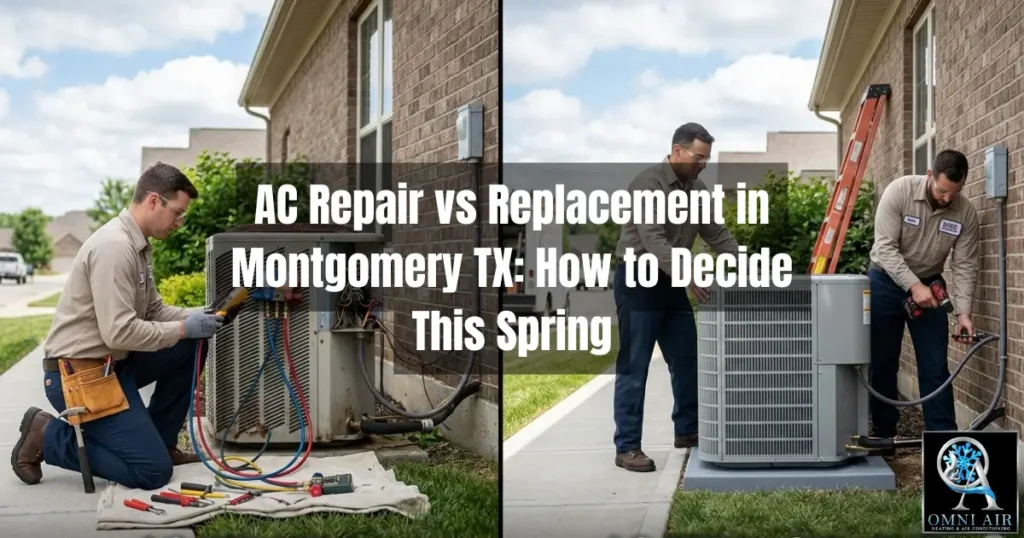
Every spring, before the Texas heat really kicks in, I get the same conversation in living rooms across Montgomery and nearby communities:
“Joseph… should we fix this thing again, or is it time to replace it?”
It’s a fair question. And it’s not one I answer lightly.
The decision between AC repair vs replacement in Montgomery isn’t just about cost today, it’s about reliability in July, energy bills in August, and peace of mind when it’s 100 degrees outside. Let me walk you through how I help homeowners decide.
First Thing I Look At: System Age
When I step up to an outdoor unit, I always check the manufacture date first.
In Texas, most AC systems last:
- 10–15 years with proper maintenance
- Less if neglected
- Sometimes longer if exceptionally maintained
If your system is under 10 years old and the repair is minor, repair usually makes sense.
But once we’re past 12–15 years? That conversation changes.
I recently inspected a 16-year-old unit that needed a compressor. The repair alone was several thousand dollars. At that point, putting that kind of money into an aging system didn’t make financial sense.
Second: What’s Actually Failing?
Not all repairs are equal.
Minor Repairs:
- Capacitors
- Contactors
- Drain line clogs
- Thermostat issues
These are routine. I fix these every week.
Major Repairs:
- Compressor failure
- Evaporator coil leaks
- Repeated refrigerant loss
- Multiple part failures in a short time
When major components start failing, it’s often a sign the system is wearing out overall, not just one part. Spring is the best time to make this call because you’re not under emergency pressure yet.
Third: The 50% Rule I Use
Here’s a practical guideline I share with homeowners:
If a repair costs 50% or more of the value of a new system, and your unit is over 10–12 years old, replacement is usually the smarter long-term move.
I’ve seen homeowners spend $1,500 in spring… then another $1,200 in August… and still replace the system by next year.
That’s money that could’ve gone toward a new, efficient system from the start.
Fourth: Energy Efficiency & Monthly Bills
Older AC systems often operate at lower SEER ratings compared to modern high-efficiency models.
I’ve personally seen homeowners reduce cooling bills noticeably after upgrading from a 10 SEER unit to a modern high-efficiency system.
If your system runs constantly and struggles to cool evenly, replacement may improve comfort and reduce operating costs long term.
Fifth: How Reliable Do You Need It to Be?
This one is personal.
Some homeowners are comfortable repairing and squeezing a few more years out of a system.
Others don’t want to risk:
- A July breakdown
- Emergency service delays
- Weekend repair costs
Spring gives you the advantage of planning instead of reacting.
Why Choose Omni Air for HVAC Repairs and Replacement
At Omni Air & Heating LLC, we approach every repair vs replacement decision with transparency.
✔ Honest System Assessments
We evaluate the full condition of your equipment, not just the broken part.
✔ Clear Cost Comparisons
We break down repair costs versus replacement options so you can make an informed decision.
✔ High-Quality Installation Standards
If replacement is the better route, proper AC installation ensures long-term efficiency and reliability.
✔ Texas Climate Expertise
We size and install systems specifically for Montgomery heat load demands.
Our goal isn’t to “sell” a replacement. It’s to recommend what makes the most sense for your comfort and budget.
Frequently Asked Questions
1. How do I decide between AC repair vs replacement in Texas?
Consider system age, repair cost, efficiency, and reliability. If your unit is over 10–15 years old and the repair is expensive, replacement may be the better long-term option.
2. Is it better to repair an older AC unit?
Minor repairs are often worthwhile, but repeated major repairs on an aging system may indicate replacement is more cost-effective.
3. What is the 50% rule for AC replacement?
If a repair costs 50% or more of the price of a new system and the unit is over 10 years old, replacement is often recommended.
4. Does replacing an AC reduce energy bills?
Yes. Modern systems are typically more energy-efficient and may reduce cooling costs compared to older units.
5. Is spring the best time to replace an AC in Texas?
Yes. Spring allows homeowners to schedule installation before peak summer demand and avoid emergency situations.
Final Thoughts
When it comes to AC repair vs replacement in Montgomery, there isn’t a one-size-fits-all answer.
But here’s what I’ve learned from years in the field:
If your system is young and the repair is minor — fix it.
If it’s aging, inefficient, and stacking repair bills — it may be time to upgrade.
Spring gives you the breathing room to decide wisely before the Texas heat makes the decision for you.
Recent Articles:
- Does AC Maintenance Really Prevent Breakdowns During Texas Summers?
- Spring AC Maintenance Checklist for Texas Homes (Before the Heat Hits)

Joseph Miller is the owner and lead Heating & Air Conditioning Specialist at Omni Air & Heating LLC, proudly serving Montgomery, Texas and surrounding communities since 2020. Joseph brings hands-on experience diagnosing, repairing, and installing residential and light commercial heating and cooling systems. His expertise includes air conditioning systems, heat pumps, furnace repair, system replacements, ductless mini splits, and indoor air quality solutions designed for the unique climate conditions of Southeast Texas.
0 Comments